TL;DR:
- Sustainable upgrades can increase property value by 4 to 10% and often offer over 100% ROI.
- Illinois homeowners benefit from incentives, codes, and phased renovation strategies focused on envelope first.
- Proper sequencing—envelope, systems, then renewable energy—maximizes efficiency and financial returns.
Most homeowners assume going green means spending more money upfront with little financial return. That assumption is wrong. Sustainable upgrades boost property value by 4 to 10%, and some improvements like insulation and garage door replacements can return over 100% of their cost at resale. For Illinois property owners, the math gets even better when you factor in state and federal incentives, lower utility bills, and rising buyer demand for energy-efficient homes. This guide walks you through the codes, strategies, and financial tools that make sustainable renovation a smart move, not just an ethical one.
Table of Contents
- Why choose sustainable renovation in Illinois?
- Understanding Illinois renovation codes and incentives
- Core sustainable renovation strategies
- Measuring the impact: ROI, payback, and environmental gains
- Our perspective: What most ‘green’ renovation guides miss in Illinois
- Take the next step: Expert remodeling for sustainable results
- Frequently asked questions
Key Takeaways
| Point | Details |
|---|---|
| Sustainable ROI highest in Illinois | Upgrade insulation, garage doors, or hardwood to see the best payback and boost resale value. |
| Use codes and incentives | Illinois offers codes and rebates that can offset up to 75% of sustainable renovation costs. |
| Phased or comprehensive plans work | Start with energy audits and envelope upgrades, then expand to systems for the greatest efficiency impact. |
| Track results for proof | Document before-and-after performance to show energy, cost, and environmental gains. |
Why choose sustainable renovation in Illinois?
Sustainable renovation is not a trend. It is a financial strategy with measurable returns. Illinois homeowners who invest in energy-efficient upgrades consistently see lower monthly utility costs, improved indoor air quality, and stronger resale numbers. That combination is hard to beat with any other home improvement category.
The numbers back this up. Certain improvements achieve ROI over 100%, meaning you recover more than you spend when you sell. Insulation, energy-efficient windows, HVAC upgrades, and LED lighting commonly recoup between 68% and 117% of their cost. For a property in Chicago or the surrounding suburbs, that translates directly into a stronger listing price and faster sale.
Beyond resale, the environmental case is compelling. Buildings account for a significant share of total U.S. greenhouse gas emissions. When you upgrade insulation, switch to efficient heating systems, or install low-flow fixtures, you reduce your property’s carbon output year after year. Environmental sustainability in real estate is increasingly tied to long-term asset value, meaning greener properties carry lower risk for buyers and lenders alike.
Here are the upgrades Illinois homeowners most commonly prioritize for their cost-to-benefit ratio:
- Insulation and air sealing: Highest ROI category, reduces heating and cooling loads immediately
- HVAC system upgrades: Modern heat pumps and high-efficiency furnaces cut energy use by 20 to 50%
- Energy-efficient windows: Reduce heat loss in Illinois winters and lower summer cooling demand
- LED lighting and smart controls: Low upfront cost, fast payback, often under two years
- Water-efficient fixtures: Reduce utility bills with minimal installation disruption
Pro Tip: Rank your planned upgrades by cost-to-benefit ratio before you start. Envelope improvements like insulation and air sealing almost always come first because they make every other system more effective. Skipping this step often means oversizing your HVAC and wasting money on equipment you did not need.
If you want to maximize Illinois value through smart design choices, the sequencing of your upgrades matters as much as the upgrades themselves.
Understanding Illinois renovation codes and incentives
Illinois has made real progress on energy efficiency standards. The state adopted the 2024 International Energy Conservation Code (IECC) for new construction and major renovations. According to Illinois energy efficiency code updates, this change saves homeowners between $2,496 and $3,790 per home over time through reduced energy costs. A voluntary 2026 Stretch Energy Code is also available for owners who want to go further and qualify for additional incentives.

For most homeowners, code compliance is triggered by the scope of work. A full gut renovation or addition typically requires full IECC compliance. Smaller repairs and cosmetic updates usually do not. Knowing where your project falls on that spectrum helps you plan documentation and inspections correctly.
Here is a step-by-step overview of how to approach code compliance and incentive applications:
- Determine whether your project triggers IECC compliance based on scope
- Review the 2026 Stretch Energy Code if you want to qualify for maximum rebates
- Apply for federal and state incentives before construction begins
- Document all existing conditions with photos, energy bills, and inspection reports
- Keep receipts and contractor certifications for all qualifying upgrades
- Submit rebate applications within the required window after project completion
On the incentive side, the numbers are significant. Up to $12,000 in rebates is available through the HOMES and HEAR programs funded by the Inflation Reduction Act (IRA). These programs cover electrification upgrades like heat pumps, electric water heaters, and insulation. In some cases, incentives can offset up to 75% of total project costs, which fundamentally changes the financial picture for major renovations.
| Incentive Program | Max Benefit | Eligible Projects |
|---|---|---|
| Federal IRA Tax Credit | 30% of cost | Solar, HVAC, insulation, windows |
| HOMES Rebate | Up to $8,000 | Whole-home energy efficiency upgrades |
| HEAR Rebate | Up to $14,000 | Electrification and appliance upgrades |
| Illinois Climate Bank Loans | Low-interest financing | Residential and commercial projects |
Pro Tip: Apply for incentive programs before breaking ground. Many rebates require pre-approval or baseline energy audits, and missing that step means leaving money on the table.
For a full breakdown of current requirements, the Illinois renovation standards guide covers compliance steps in detail. If you are still in the planning phase, the prepare for renovations guide is a good starting point. You can also review strategies to reduce renovation carbon footprint during the construction process itself.
Core sustainable renovation strategies
The most effective sustainable renovations follow a logic: fix the building shell first, then upgrade the systems inside it. This approach, often called a deep energy retrofit, targets 30 to 75% energy reduction by combining insulation, air sealing, windows, and mechanical upgrades into a coordinated plan.
A deep energy retrofit is not always practical in one phase. That is where the phased versus comprehensive debate comes in.
| Approach | Best For | Key Advantage | Main Risk |
|---|---|---|---|
| Phased upgrades | Budget-limited owners | Spread costs over time | Systems may conflict if not planned together |
| Comprehensive retrofit | Owners with full budget | Maximum efficiency gains | Higher upfront investment |
| Hybrid approach | Most Illinois homeowners | Balances cost and performance | Requires careful sequencing |
For most Illinois homeowners, a hybrid approach works best. Start with an energy audit to identify where your property loses the most energy. Then address the envelope: insulation, air sealing, and windows. Once the envelope is tight, your heating and cooling loads drop, which means you can install a smaller, less expensive HVAC system. That sequencing alone can save thousands of dollars.
Here are the core strategies that deliver the strongest results:
- Energy audit first: Establishes baseline and identifies priority areas
- Air sealing: Often the single highest-return improvement in older Illinois homes
- Insulation upgrades: Attic, wall, and basement insulation all reduce load
- Window replacement: Focus on north and west-facing windows for Illinois climate
- Heat pump installation: Works efficiently even in cold Illinois winters with modern cold-climate models
- Solar readiness: Wire for solar during electrical upgrades to reduce future installation costs
“The biggest mistake we see is homeowners upgrading HVAC before sealing the envelope. You end up with an oversized system that cycles on and off constantly, wears out faster, and never delivers the comfort or savings you expected.”
For guidance on evaluating contractor work during this process, the inspect renovation quality resource is worth reviewing. When selecting materials, the choose remodeling materials guide covers sustainable options by category. You can also explore sustainable building practices for a broader look at what leading property managers are implementing in 2026.
Measuring the impact: ROI, payback, and environmental gains
Knowing which upgrades to make is only half the job. Knowing how to measure and communicate their value is what separates a good renovation from a great investment.
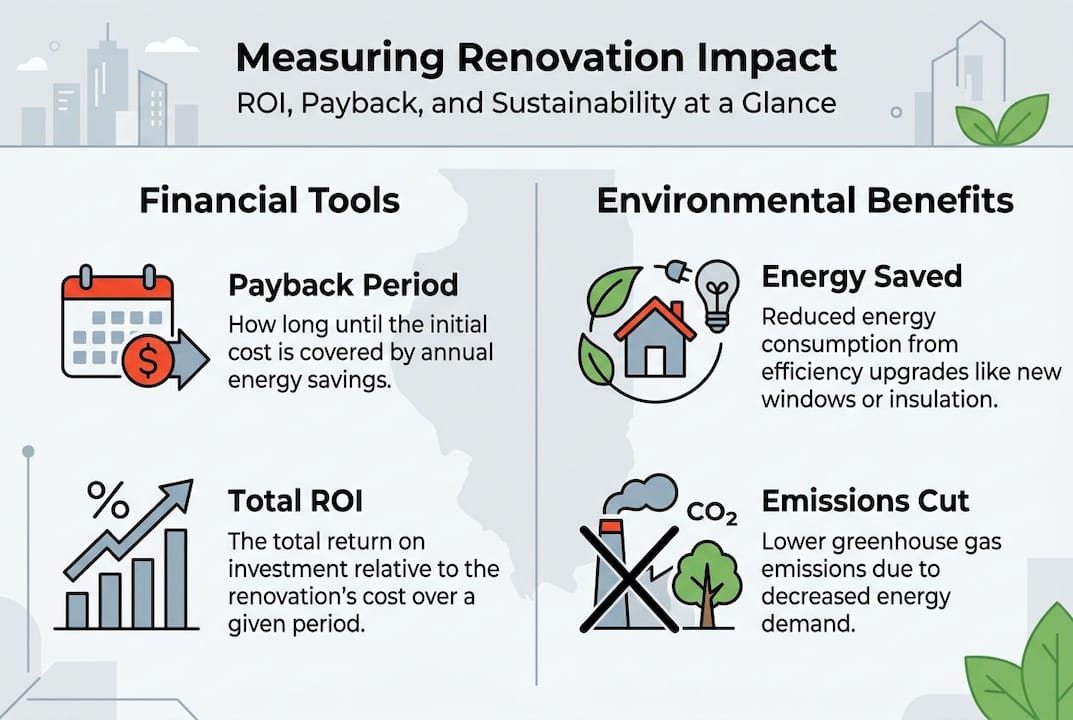
Three financial tools matter most here. Payback period tells you how many years it takes for energy savings to cover the upfront cost. Net present value (NPV) accounts for the time value of money and gives you a more accurate picture of long-term returns. NPV and payback period are the key metrics used in cost-benefit analysis for energy renovations, and actual returns vary based on energy prices and local discount rates.
| Project Type | Typical ROI | Estimated Payback Period |
|---|---|---|
| Garage door replacement | 100 to 250% | Immediate at resale |
| Insulation upgrade | 100 to 117% | 3 to 7 years |
| Energy-efficient windows | 68 to 71% | 7 to 12 years |
| HVAC upgrade | 75% | 5 to 10 years |
| LED lighting conversion | 85 to 95% | 1 to 3 years |
For Illinois specifically, property value increases of 4 to 10% are realistic for homes with documented energy-efficient upgrades. That premium is growing as buyers become more energy-cost aware.
On the environmental side, track these metrics before and after your renovation:
- Annual energy consumption in kilowatt-hours (kWh)
- Natural gas usage in therms
- Estimated greenhouse gas (GHG) emissions in metric tons of CO2 equivalent
- Water consumption in gallons per year
- Waste diverted from landfill during construction
Pro Tip: Document baseline conditions before any work begins. Take photos, pull 12 months of utility bills, and note any existing system specs. That data becomes your before-and-after story, which is valuable for resale, incentive applications, and environmental reporting.
For projects involving permits, the permit delays guide covers how to keep your timeline on track when approvals slow things down.
Our perspective: What most ‘green’ renovation guides miss in Illinois
Most green renovation content focuses on product lists: better windows, smarter thermostats, low-VOC paint. That is useful, but it misses the bigger picture. The real variable in sustainable renovation ROI is not what you install. It is the order in which you install it.
We have seen Illinois homeowners spend $15,000 on a new HVAC system before addressing a leaky attic, only to find their energy bills barely moved. The system was fighting against a building envelope that could not hold conditioned air. That is not a product failure. It is a sequencing failure.
The whole-system design approach we use treats a property as an integrated system, not a collection of independent upgrades. Envelope first, then mechanical, then renewable energy. That sequence is backed by deep energy retrofit research and consistently delivers better outcomes than piecemeal approaches.
Illinois also has specific climate and utility cost patterns that generic guides ignore. Our winters demand high heating performance. Our utility rate structures affect payback calculations differently than warmer states. There is no universal formula here.
Pro Tip: Treat your renovation as a unique system design project, not a checklist. Every property has a different starting point, and the best plan accounts for that.
Take the next step: Expert remodeling for sustainable results
You now have a clear picture of what sustainable renovation looks like in Illinois, from codes and incentives to sequencing and ROI measurement. The next step is putting that knowledge into action with a team that knows the Illinois market.

First Solution IL works with homeowners and property managers across Illinois to plan and execute renovations that deliver real financial and environmental returns. Whether you are starting with a single room or planning a full property upgrade, our step-by-step renovation guide gives you a practical framework. Explore our remodeling services for Illinois homes to see how we approach each project, or review our commercial remodeling explained page if you manage commercial properties. Contact us for a free estimate and let us build a plan that works for your budget and goals.
Frequently asked questions
What is the 2026 Stretch Energy Code in Illinois and who should use it?
The 2026 Stretch Energy Code is a voluntary standard for Illinois renovations that targets higher efficiency than the mandatory 2024 IECC baseline. It is best suited for owners who want maximum energy savings and access to the highest-tier rebates and incentives.
Which sustainable renovation projects offer the highest ROI in Illinois?
Insulation, garage door replacement, and hardwood refinishing consistently deliver the strongest returns, with insulation and garage doors achieving ROI over 100% at resale. LED lighting upgrades also pay back quickly, often within one to three years through utility savings alone.
Are there rebates available for commercial as well as residential sustainable renovations in Illinois?
Yes. The HOMES and HEAR programs, funded through the IRA, apply to both residential and many commercial upgrades. Up to 75% of project costs can be offset through combined federal, state, and utility incentives for qualifying electrification projects.
How do I document environmental benefits for my renovation project?
Collect 12 months of pre-renovation utility bills, note existing system specs, and track post-renovation energy and water use. NPV and payback period metrics along with GHG reduction data give you a complete picture for reporting, resale disclosures, or incentive verification.