

TL;DR:
- Many Illinois property owners mistakenly believe ADA requirements only affect new construction, but renovations also trigger compliance obligations. When altering primary function areas, owners must prioritize accessible entrances, routes, and facilities, with costs capped at 20% of renovation expenses. Following proper standards and involving accessibility experts early ensures legal compliance, minimizes costly retrofits, and creates accessible, valuable spaces.
Many property owners in Illinois assume ADA requirements kick in only when breaking ground on a brand-new building. That assumption is expensive. The moment you alter an existing commercial space, remodel a storefront, or reconfigure a floor plan, federal law may require you to bring far more than just the renovated area into compliance. Missed obligations can result in complaints, lawsuits, permit rejections, and costly retrofits after the fact. This guide breaks down exactly what triggers ADA compliance during a renovation, what you must upgrade, which technical standards apply, and how to navigate Illinois-specific resources so your project moves forward without surprises.
Table of Contents
- ADA basics and renovation triggers
- What must be accessible: The scope of required upgrades
- Understanding the technical standards: 2010 ADA and PROWAG
- Navigating Illinois-specific steps and getting expert help
- Why most ADA renovation plans in Illinois fall short—and how to get them right
- Ready for full ADA-compliant renovations in Illinois?
- Frequently asked questions
Key Takeaways
| Point | Details |
|---|---|
| ADA often applies to renovations | Most Illinois renovation projects must satisfy ADA in addition to state/local codes. |
| Key triggers and limits | Altering a primary function area can trigger extra upgrades but with a 20% path-of-travel spending cap. |
| Use correct technical standards | 2010 ADA Standards and, for sidewalks, PROWAG, define mandatory accessibility benchmarks. |
| Check both federal and Illinois rules | ADA compliance is not the same as Illinois Accessibility Code—verify requirements for both. |
| Expert help prevents costly mistakes | Seek local ADA advice and involve compliance checks early to avoid major project setbacks. |
ADA basics and renovation triggers
Now that you understand ADA obligations aren’t limited to new construction, let’s clarify exactly how renovations can trigger these requirements.
The Americans with Disabilities Act covers a much wider range of projects than most owners expect. It doesn’t just regulate purpose-built accessible facilities. It also governs any work that changes how an existing space functions. That’s the key word: usability. When your project changes how people move through, use, or access a space, the ADA notices.
Under ADA Title III, which covers commercial and public accommodations, alterations are defined broadly to include remodeling, renovating, rehabilitating, reconstructing, changing or rearranging plan configuration, and other changes that affect usability. In short, almost any meaningful renovation qualifies as an alteration and must make the altered areas accessible to the maximum extent feasible. Even moving a wall to open up a retail floor plan or reconfiguring a checkout counter can bring ADA obligations with it.
The primary technical benchmark for these alterations is the 2010 ADA Standards for Accessible Design, which serves as the baseline for what must be met during design, construction, and alteration activities for both Title II (government entities) and Title III (private businesses and commercial facilities).
Here are the most commonly affected property types in Illinois:
- Private businesses open to the public, including restaurants, retail stores, offices, and medical facilities
- Multi-tenant commercial buildings where alterations affect common areas
- Mixed-use properties that include any public accommodation
- Government-owned facilities regulated under Title II
One critical distinction worth making early: ADA compliance is separate from the Illinois Building Code. Both can apply to your project simultaneously, and meeting one doesn’t guarantee you’ve satisfied the other. Your Illinois renovation compliance guide and a review of the Illinois building code overview should both be part of your planning process from day one.
Key takeaway: If your renovation changes how people use or move through a space, assume the ADA applies. Verify with a qualified accessibility reviewer before finalizing plans.
What must be accessible: The scope of required upgrades
Since almost any alteration can trigger ADA review, it’s crucial to know which spaces fall under compliance and what order to address them.
This is where renovation projects get complicated, and where most owners get caught off guard. The ADA doesn’t just require you to make the room you’re remodeling accessible. If you alter what’s called a primary function area, you may also be required to upgrade the path of travel leading to and from that area.
A primary function area is any space where the main purpose of the facility takes place. Think of a restaurant dining room, a bank lobby, a retail sales floor, or a corporate conference room. When you renovate any of these, the ADA can require you to also improve:
- The accessible entrance to the building
- The accessible route from that entrance to the renovated area
- Restrooms serving the renovated area
- Drinking fountains and telephones if applicable
- Signage along the path of travel
That’s a much longer list than most owners plan for. The good news is that path-of-travel spending is capped at 20% of the cost allocated to the primary function area alteration. This is called the disproportionality rule, and it exists to prevent compliance costs from becoming prohibitive.
Here’s a practical example. If you spend $100,000 renovating a restaurant dining room, you are required to spend up to $20,000 on path-of-travel upgrades. If full path-of-travel compliance would cost $35,000, you are not required to spend more than $20,000. But you must prioritize upgrades in the correct order so the most critical access points are addressed first.
| Priority order | What to upgrade first |
|---|---|
| 1 | Accessible entrance to the building |
| 2 | Accessible route from entrance to primary function area |
| 3 | Accessible restroom serving the area |
| 4 | Drinking fountains on the accessible route |
| 5 | Telephones and additional signage |
This order matters legally. If your $20,000 cap runs out after the entrance and route, you document that restrooms weren’t upgraded because the cost was disproportionate. You don’t skip the entrance to upgrade the restroom instead.

Pro Tip: Request itemized bids from your contractor that separately break out costs for the primary function area and path-of-travel work. This documentation protects you if your compliance decisions are ever questioned.
Navigating Illinois renovation permits and compliance and the broader Illinois commercial remodeling steps both reinforce why building ADA cost analysis into the early bid stage, not after contracts are signed, is essential.
Understanding the technical standards: 2010 ADA and PROWAG
With the scope established, the next question is how to meet those expectations. The right technical standards are critical for getting it right.
There are two primary frameworks you need to understand: the 2010 ADA Standards for Accessible Design and PROWAG, which stands for the Public Rights-of-Way Accessibility Guidelines.
The 2010 ADA Standards cover interior and exterior elements within your property, including routes, restrooms, parking, ramps, signage, and more. These are the rules your architect and contractor work from when designing and building accessible features inside and around your facility.
PROWAG is different. It applies specifically to the public right-of-way, which includes sidewalks, crosswalks, and pedestrian routes on public land adjacent to your property. During construction, if your work disrupts these areas, you are responsible for providing accessible alternatives. The CMAP guidance for Illinois is clear that organizations must plan for accessible temporary or alternate pedestrian access routes and should align those plans with PROWAG technical requirements during construction.
Here’s a comparison to clarify which standard applies to what:
| Element | Applicable standard |
|---|---|
| Interior corridors and restrooms | 2010 ADA Standards |
| Accessible parking and ramps on-site | 2010 ADA Standards |
| Sidewalks during active construction | PROWAG temporary routes |
| Permanent exterior pedestrian routes | 2010 ADA Standards |
| Crosswalks adjacent to construction zone | PROWAG |
The ADA National Network fact sheet summarizes practical walking-surface thresholds used in ADA Standards, including minimum accessible route widths and slope limits. It also emphasizes that both temporary and permanent pedestrian routes on a site must meet ADA Standards.
Some specific benchmarks to build into your design and construction documents:
- Minimum accessible route width: 36 inches clear at all points
- Maximum running slope: 5% (1:20 ratio) for accessible routes that aren’t ramps
- Maximum cross slope: 2% for accessible walking surfaces
- Ramp slope: no steeper than 8.33% (1:12 ratio)
- Door clear width: minimum 32 inches when open to 90 degrees
Pro Tip: One of the most common and costly mistakes we see on Illinois renovation projects is using permanent-construction ADA dimensions for temporary construction routes, or vice versa. Confirm with your project team which standard applies to each element before breaking ground.
Verifying your plans against the correct ADA compliance standards early in the design phase prevents expensive field corrections later.
Navigating Illinois-specific steps and getting expert help
After understanding both federal and core technical rules, you’re ready to see exactly how Illinois-specific processes tie into your project.
ADA compliance and Illinois state accessibility requirements overlap in important ways, but they are not identical. Illinois has its own Accessibility Code, which is enforced through the Illinois Capital Development Board (CDB). The CDB has the authority to interpret the Illinois Accessibility Code formally, and their guidance can differ from federal ADA guidance in specific technical areas. When the two differ, you generally apply whichever standard is more stringent.
The Illinois ADA Project FAQ provides a useful breakdown: the Illinois ADA Project provides informal technical assistance, and for formal guidance on the Illinois Accessibility Code you should contact the Illinois Capital Development Board. The FAQ also flags coverage under the Illinois Environmental Barriers Act and the role of “readily achievable” barrier removal for existing facilities.
The phrase “readily achievable” is a legal term that means easily accomplishable without much difficulty or expense. It’s the standard that applies to barrier removal in existing buildings that aren’t being altered. If you’re just removing architectural barriers without a full renovation, readily achievable is your standard, which is lower than the alteration standard. But once you cross into formal alterations, the higher compliance threshold applies.
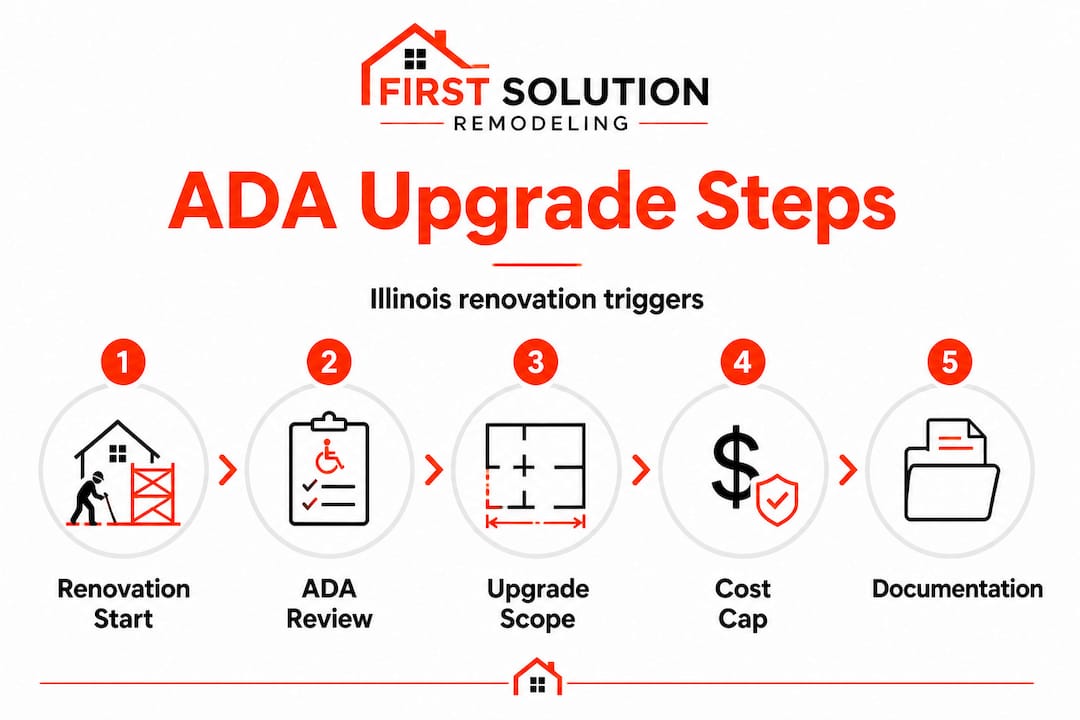
Here’s a practical checklist for Illinois property owners managing ADA compliance during renovation:
- Step 1: Determine if your project qualifies as an “alteration” under the ADA definition
- Step 2: Identify whether you’re altering a primary function area
- Step 3: Calculate your path-of-travel budget at 20% of primary area alteration costs
- Step 4: Prioritize path-of-travel upgrades in the correct order
- Step 5: Verify which technical standard (2010 ADA, PROWAG, or Illinois Accessibility Code) applies to each element
- Step 6: Contact the Illinois ADA Project for informal guidance or the CDB for formal code interpretation
- Step 7: Document all decisions, especially if you’re invoking the disproportionality cost cap
Pro Tip: Don’t rely solely on your general contractor to interpret ADA law. Contractors build to specifications; they are not accessibility attorneys or certified accessibility consultants. Bring in a specialist to review plans before permit submission.
Reviewing Illinois renovation building codes alongside your ADA checklist, and consulting the Illinois renovation quality guide, helps ensure nothing slips through the cracks between state and federal requirements.
Why most ADA renovation plans in Illinois fall short—and how to get them right
Here’s something that surprises most property owners we work with: the majority of ADA compliance failures in Illinois renovation projects aren’t caused by ignorance of the law. They’re caused by a very specific and very avoidable misunderstanding: the belief that upgrading the interior primary function area is enough.
This is the single most common trap. An owner budgets carefully for a beautiful restroom remodel or a reconfigured office floor plan, gets the work done expertly, and then discovers during a complaint review or permit audit that the accessible entrance to the building, or the corridor leading to the renovated space, didn’t meet current standards. Suddenly they’re facing a second round of construction costs they never planned for.
The Great Lakes ADA Center guidance is clear that path-of-travel updates are potentially triggered anytime you alter a primary function area, and that the required scope is limited by the 20% cost cap. That cap is helpful, but only if you plan for it from the beginning. Owners who discover path-of-travel obligations after the primary work is complete don’t have the benefit of integrating those costs into the overall bid.
Our experience shows that the most successful ADA-compliant renovation projects in Illinois share three habits. First, the owner involves an accessibility reviewer at the design stage, not after the build. Second, the project team conducts a checkpoint review at plan submission and again after contractor bids come in, to verify nothing changed that shifts the compliance picture. Third, the owner keeps documented records of every ADA decision, including cost cap calculations and upgrade prioritization rationale.
The value of interior renovations done right goes beyond aesthetics. Accessible spaces serve more customers, reduce legal risk, and position your property for long-term value. The property owners who treat ADA planning as an afterthought spend far more money fixing problems than those who treat it as a core project requirement from day one.
Ready for full ADA-compliant renovations in Illinois?
Knowing the rules is only half the challenge. Executing a renovation that meets both federal ADA requirements and Illinois state standards requires experienced hands and a proven workflow.

At First Solution IL, we work with commercial property owners and residential clients across Illinois to plan and execute renovations that check every compliance box without unnecessary delays or budget surprises. From permit coordination to path-of-travel assessments, our team understands how top Illinois renovation services should be delivered with ADA compliance built in from the first walkthrough. We follow a smooth remodeling workflow that integrates code review, accessibility checkpoints, and quality inspections at every phase. If you’re planning a renovation and want to get compliance right the first time, reach out to us for a consultation. We’ll help you map your project against current standards and understand your interior remodeling obligations before a single permit is filed.
Frequently asked questions
Does the ADA apply to privately owned commercial buildings in Illinois?
Yes, nearly all private businesses open to the public are covered under ADA Title III, regardless of ownership structure or building age.
What is the 20% path-of-travel rule for ADA renovations?
When you alter a primary function area, ADA limits required spending on path-of-travel accessibility to 20% of the project’s cost for that area. Path-of-travel compliance is capped at this amount and must follow a prioritized upgrade order.
What technical standard do Illinois renovations follow for accessibility?
Renovations must meet the 2010 ADA Standards for Accessible Design, and in some cases local Illinois Accessibility Code requirements. When the two differ, the stricter rule applies.
Where can I get official ADA advice for a renovation in Illinois?
The Illinois ADA Project provides informal technical assistance. For formal Illinois Accessibility Code questions, contact the Illinois Capital Development Board directly.
Do I need to upgrade the sidewalk outside during renovation construction?
If your renovation impacts the public right-of-way, you must provide accessible temporary routes or alternate pedestrian access routes following PROWAG technical requirements throughout the construction period.