

TL;DR:
- Effective Illinois commercial renovation relies on early planning, correct IEBC pathway selection, and comprehensive documentation.
- Skipping procedural steps like zoning verification, lease clarity, and system commissioning often leads to delays, increased costs, and future legal issues.
Commercial property owners in Illinois know the pain well: a renovation or build-out that looked straightforward on paper turns into a timeline disaster the moment unexpected code requirements surface or a poorly worded lease clause shifts cost responsibility in the wrong direction. The difference between a smooth transformation and an expensive stall almost always comes down to process, not design. This guide walks you through every critical stage of a commercial space transformation in Illinois, from pre-project compliance groundwork to final closeout documentation, so you finish on time, within budget, and with a space that holds its value for years.
Table of Contents
- What you need before you start: Codes, contracts, and prerequisites
- Step-by-step process for transforming your commercial space
- Common pitfalls and how to avoid them
- Verifying success: Compliance, documentation, and long-term value
- What most owners miss about commercial space transformation in Illinois
- Transform your Illinois commercial space with expert support
- Frequently asked questions
Key Takeaways
| Point | Details |
|---|---|
| Start with code pathway | Selecting the right compliance approach in Illinois saves you costly changes down the road. |
| Clarify TI agreements | Well-structured tenant improvement terms protect you from unexpected costs and delays. |
| Prioritize documentation | Final closeout paperwork and commissioning ensure long-term compliance and peace of mind. |
| Plan for zoning shifts | Changing the use or occupancy can trigger extensive new requirements, so address them early. |
What you need before you start: Codes, contracts, and prerequisites
Most project delays and budget blowouts in Illinois commercial renovations don’t start on the job site. They start weeks earlier, when owners skip the foundational planning work that determines what the project actually requires. Getting this stage right protects your timeline and your wallet.
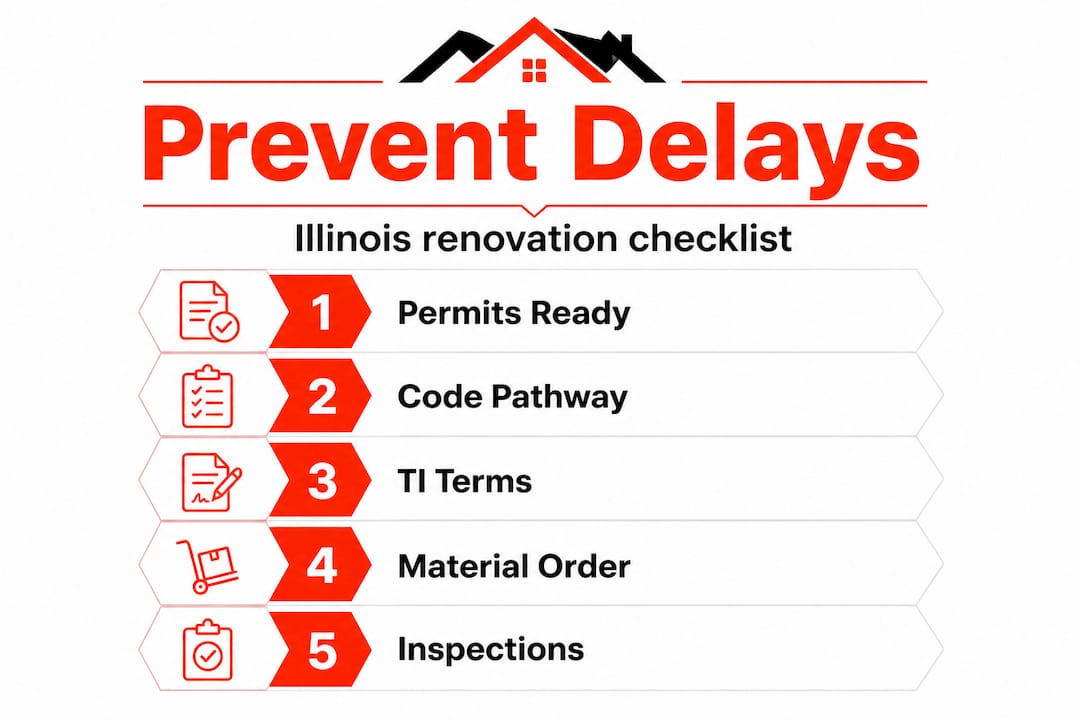
Understanding IEBC compliance pathways
Illinois adopts the International Existing Building Code (IEBC), which offers three distinct pathways for renovating or repurposing existing structures: Prescriptive, Work Area, and Performance. Each pathway carries different regulatory requirements, different scopes of required upgrades, and significantly different costs.
The Prescriptive pathway focuses on specific component-level rules and is generally the simplest. The Work Area pathway scales requirements based on how much of the building you’re altering. The Performance pathway allows you to demonstrate that your building meets an overall safety standard, which gives flexibility but demands detailed engineering documentation.
Critically, code-compliance pathway selection drives both cost and scope for Illinois renovation and adaptive-reuse decisions. This is not a detail to sort out after you’ve finalized your design. Choosing the wrong pathway, or ignoring pathway selection entirely, can force expensive redesigns midway through construction.
Your architect or engineer should evaluate all three pathways during the earliest project phase and present a clear recommendation based on your specific building, use type, and budget targets. Visit our Illinois remodeling guide for a deeper look at how this works in practice.
Tenant improvement mechanics and lease structure
If your project involves a tenant improvement (TI) build-out, the lease structure is just as important as any construction plan. TI build-outs require careful structuring around allowance amount, scope of covered work, whether the allowance is calculated on rentable or usable square footage, who absorbs cost overruns, and what the payment disbursement conditions look like.
Owners who treat TI allowance as a straightforward lump sum often discover too late that the fine print limits what they can spend it on, or that overrun responsibility falls squarely on them. Nail down these lease mechanics in writing before any architectural work begins.
“The lease is the project’s financial blueprint. If it’s vague on scope or overrun responsibility, you’re assuming risk you probably don’t realize you’re carrying.” This holds true whether you’re the landlord funding the build or an owner-occupant managing the build-out directly.
Pre-project checklist
Before you commission architectural plans or schedule a contractor, gather and confirm the following:
- Zoning confirmation: Verify your intended use is permitted under current zoning. Changes in occupancy classification trigger a separate set of requirements.
- Existing building documentation: Collect as-built drawings, previous permit records, structural reports, and any prior code violation history.
- Utility capacity: Confirm that existing electrical, plumbing, and HVAC capacity supports your intended use without major upgrades.
- ADA baseline assessment: Identify any accessibility deficiencies that a project of your scale is required to correct.
- Lease or ownership documents: Clarify all TI provisions, construction approval rights, and restoration obligations.
- Local authority pre-application meeting: Schedule a pre-application meeting with your city’s building department before finalizing plans.
Pro Tip: Engaging city building officials early, before plans are drawn, often reveals jurisdiction-specific requirements that aren’t obvious from a code read. One conversation can save weeks of redesign. See our guide on renovation permit compliance to learn what Illinois municipalities commonly flag.
| IEBC pathway | Best for | Key advantage | Typical cost impact |
|---|---|---|---|
| Prescriptive | Minor to moderate renovations | Simple, rule-based compliance | Lowest upfront cost |
| Work Area | Partial or phased renovations | Scales to renovation scope | Moderate, scope-dependent |
| Performance | Complex adaptive reuse | Maximum design flexibility | Higher documentation cost |
Step-by-step process for transforming your commercial space
Prepared with your requirements in place, it’s time to break down the actual transformation into manageable, actionable steps.
Step 1: Assess your space and define intended use
Start with a thorough existing-conditions assessment. Walk every inch of the space with a licensed architect or contractor and document current conditions, structural limitations, and any deferred maintenance. If you’re changing the occupancy classification, for example converting office space to retail or food service, identify this at the very beginning. Occupancy changes trigger additional code requirements, including fire separation, egress, mechanical upgrades, and potentially parking. Reviewing Illinois office renovation steps can give you a practical frame for this stage.

Step 2: Select your IEBC compliance pathway and engage design professionals
Based on your assessment, your architect and engineer should formally select the IEBC compliance pathway that fits your project. Document this selection. It becomes the governing framework for every design decision that follows. Pathway selection drives scope and cost more than almost any other single choice you make.
Step 3: Structure your TI agreement or build-out terms
If a TI allowance is involved, formalize all terms before design documents are completed. Lease/allowance structuring details like payment milestones, scope limitations, and overrun responsibility should be explicit, not implied. Get these terms reviewed by a real estate attorney familiar with Illinois commercial leases.
Step 4: Secure permits, schedule inspections, and procure materials
Submit permit applications early. Illinois municipalities vary significantly in review timelines, ranging from a few weeks in smaller jurisdictions to several months in Chicago. Identify which inspections are required at which project milestones and build them into your construction schedule. Order long-lead materials like custom doors, specialty flooring, or HVAC equipment as soon as permits are approved. Delays in material procurement are one of the most common causes of project timeline extension. Learn more about using contractors in build-outs to understand how a skilled contractor manages this stage.
Step 5: Execute construction with close attention to inspection milestones
During active construction, maintain a current set of plans on site at all times. Designate a single point of contact between the contractor, owner, and city inspector. Address inspection comments immediately rather than letting them accumulate. Document all change orders in writing, including cost and timeline impact, before any additional work begins. Verbal agreements on change orders are a persistent source of disputes.
Step 6: Final inspection, commissioning, and closeout
Once construction is complete, schedule final inspections for all trades and systems. Do not occupy the space before receiving your Certificate of Occupancy. Commission all mechanical, electrical, and plumbing systems to verify they operate as designed, and document the results.
| Stage | Key deliverable | Common delay risk |
|---|---|---|
| Pre-design | Code pathway selection, lease terms finalized | Skipping early city consultation |
| Design | Permit-ready construction documents | Incomplete existing conditions data |
| Permitting | Approved permits, inspection schedule | Jurisdiction backlog, incomplete submissions |
| Construction | Executed change orders, inspection sign-offs | Verbal agreements, material delays |
| Closeout | Certificate of Occupancy, as-builts, O&M manuals | Missing commissioning documentation |
Pro Tip: Build a two-week buffer into every permit review period and a one-week buffer after each major inspection milestone. Buffer time is not padding. It is the difference between a project that absorbs surprises and one that falls apart.
Common pitfalls and how to avoid them
Even with a solid step-by-step process, mistakes at critical points can cost you significant time and money. Here’s where Illinois commercial projects most frequently go sideways.
Missed zoning and occupancy change requirements
Owners underestimate how much a change in use classification can expand a project’s scope. Converting office space to a restaurant, childcare facility, or medical clinic each triggers distinct fire, egress, ventilation, and parking requirements. Commercial conversions involving occupancy changes can add time-sensitive requirements around exits, parking ratios, and ADA compliance that weren’t in the original project scope.
Discovering these requirements after design documents are complete means expensive revisions. Discover them after permits are issued, and you’re looking at resubmission fees and timeline delays. Identify occupancy classification implications in Step 1, not Step 4.
Inadequate TI contract language
Vague TI agreements are one of the most reliably expensive mistakes in commercial build-outs. Clauses that don’t specify who approves contractors, who manages cost overruns, what the payment disbursement schedule looks like, and what happens if work extends past lease commencement leave owners exposed.
Push for clear, specific language on every financial and timeline obligation. If your landlord’s standard form is vague, negotiate. The cost of a real estate attorney reviewing your lease is negligible compared to the overrun exposure a poorly written TI agreement can create.
Skipping system commissioning and closeout documentation
Closeout and commissioning documentation are directly tied to compliance, warranty validity, and verified system performance. Owners who treat the final inspection as the finish line often discover months later that undocumented systems create warranty gaps or that missing as-built drawings complicate future renovations.
“A renovation isn’t done when the last nail is driven. It’s done when every system is tested, documented, and handed off properly.”
- Closeout essentials: Final inspection sign-offs from all trades, Certificate of Occupancy, as-built drawings, equipment warranties, O&M manuals, and commissioning reports.
- What to track for ADA: Document all accessibility upgrades completed and any items deferred under path-of-travel exception rules.
- What to archive: Keep permit records, inspection reports, and contractor lien waivers for the life of your ownership.
Pro Tip: Build your closeout checklist at the start of the project, not at the end. When you define what documentation you need from day one, your contractor knows to collect it during construction rather than scrambling to reconstruct records after the fact. Also review Illinois permit timing issues to anticipate when documentation gaps are most likely to surface.
Verifying success: Compliance, documentation, and long-term value
After avoiding the major project landmines, your final focus is confirming that the transformed space delivers full value and lasting legal security.
Confirming code compliance and occupancy certification
Before you move tenants in or begin operations, verify that every required inspection has been passed and formally signed off. Your Certificate of Occupancy is the legal document that confirms the space is approved for its intended use. Do not treat it as a formality. An unpermitted or under-documented renovation can create major complications during future sales, refinancing, or insurance claims.
Building your project closeout package
Retrofit project closeout documentation is directly linked to compliance, warranty activation, and your building’s future value. A thorough closeout package includes:
- Certificate of Occupancy and all final inspection approvals
- As-built drawings reflecting actual construction
- Operations and maintenance manuals for all installed systems
- Equipment warranties with manufacturer registration completed
- Commissioning reports for mechanical, electrical, and plumbing systems
- Contractor lien waivers and final payment releases
- ADA compliance documentation, including any items deferred with proper justification
Why commissioning protects long-term value
Commissioning means testing each installed system under real operating conditions and documenting that it performs to its design specifications. An HVAC system that was installed correctly but never commissioned may operate inefficiently for years before anyone identifies the problem. Proper commissioning also activates most manufacturer warranties. Skip it, and you may forfeit coverage on equipment worth tens of thousands of dollars.
For owners planning to increase space value and efficiency over time, commissioning records also serve as a baseline for future performance comparisons, an often-overlooked planning advantage. Explore Illinois space improvement ideas to see how documented improvements translate to long-term asset value.
What most owners miss about commercial space transformation in Illinois
Here’s an uncomfortable truth worth sitting with: most Illinois commercial renovation projects that run over budget or fall behind schedule don’t fail because of bad design. They fail because of skipped procedural steps, contract gaps, and sloppy closeouts.
We’ve seen beautifully designed spaces stall for months because no one confirmed the IEBC compliance pathway before architecture started. We’ve seen owners absorb five-figure cost overruns because their TI agreement didn’t specify who was responsible for unforeseen structural work. And we’ve seen renovations that passed their final inspections but created insurance headaches two years later because commissioning records were never assembled.
The owners who consistently finish on time and on budget aren’t necessarily working with the best designers. They’re working with the most disciplined process. They treat code pathway selection as a financial decision, not a technicality. They treat TI contract language as risk management, not boilerplate. And they treat closeout and commissioning documentation as a deliverable equal in importance to the physical construction itself.
Illinois’s codes are also evolving. More municipalities are adopting and actively enforcing the IEBC. That means the margin for error on compliance is shrinking. Owners who invest in process mastery, using a remodel management guide to stay organized, will consistently outperform those who treat their project as a one-time sprint. It’s not glamorous advice. But it’s the most honest thing we can tell you based on what we see on Illinois job sites every week.
Transform your Illinois commercial space with expert support
If the steps in this guide feel like a lot to coordinate on your own, that’s because they genuinely are. Permit timelines, IEBC pathway decisions, TI negotiations, and commissioning documentation all require hands-on experience to manage efficiently.

First Solution IL brings that experience directly to your project. We help Illinois commercial property owners navigate code compliance, structure build-out workflows, and execute renovations that close clean and hold their value. Our team follows a proven workflow for smooth renovations that keeps your project moving through every phase without the surprises. Whether you’re planning a full build-out or a targeted commercial upgrade, we’re ready to help you get it right from day one. Learn how to find the right contractor for your project, or visit First Solution IL to request your free project consultation today.
Frequently asked questions
What is the IEBC code-compliance pathway, and why does it matter?
The IEBC code-compliance pathway determines which regulatory requirements, upgrade scopes, and costs apply to your Illinois renovation, making it one of the most financially significant decisions in early project planning.
Which lease terms should owners clarify before starting a TI build-out?
Owners should nail down TI allowance amount, covered scope, payment disbursement schedule, and overrun responsibility before any design work begins. Lease/allowance structuring details control the real-world cost risk of your entire build-out.
How do zoning changes affect commercial conversions?
When the use classification changes, new requirements for exits, parking, and ADA compliance can quickly expand both the scope and the timeline of your project. Commercial conversion compliance shifts are especially time-sensitive and should be identified at the assessment stage.
Why does commissioning and closeout matter after renovation?
Closeout and commissioning are required for warranty activation, compliance confirmation, and verified system performance, and skipping them can create insurance and legal complications long after construction is finished.