

TL;DR:
- Proper licensing, permits, and local compliance are essential to avoid costly project shutdowns.
- Thorough vetting including insurance, references, and written documentation helps select reliable contractors.
- Active project oversight and clear communication ensure quality, on-time delivery, and regulatory adherence.
A property manager in Naperville signs a contractor without checking licenses. Three weeks in, inspectors shut the job site down for permit violations, and the project costs double. This scenario plays out more often than most property owners want to admit, and it’s almost always preventable. Choosing the right contractor in Illinois takes more than a handshake and a low bid. It requires understanding state and local compliance rules, building a solid vetting process, and staying engaged throughout the project. This guide walks you through every step so your next renovation stays on track, on budget, and fully compliant.
Table of Contents
- Understand Illinois licensing and compliance requirements
- Set clear standards for vetting and selection
- Monitor performance and ensure ongoing quality
- Avoid common pitfalls and troubleshoot issues early
- The uncomfortable truth: Quality is a partnership, not just paperwork
- Take the next step: Trusted Illinois renovation experts
- Frequently asked questions
Key Takeaways
| Point | Details |
|---|---|
| Check regional licensing | Illinois requires specialty licenses and local registration for contractors—especially in Chicago. |
| Thorough vetting is essential | Always request insurance and references to confirm contractor credibility before hiring. |
| Monitor performance consistently | Track key performance indicators like response times and issue resolution for reliable results. |
| Address issues early | Quickly resolving compliance and workmanship concerns prevents project delays and costly errors. |
| Build partnership, not just paperwork | Collaborative communication and mutual accountability deliver lasting contractor quality. |
Understand Illinois licensing and compliance requirements
Before you call a single contractor, you need to understand what Illinois actually requires of them. The answer is more nuanced than most people expect. Illinois does not issue a statewide general contractor license. That surprises a lot of property owners who assume every licensed contractor holds credentials from the state. In reality, specialty licenses are required for trades like plumbing, electrical, and roofing, while general contractors are regulated at the local level.
This local focus matters enormously. A contractor who works legally in Springfield may not meet the requirements for a project in Chicago. The Chicago Department of Buildings (DOB) runs its own permitting and inspection system, and it takes compliance seriously. Skipping the DOB process in Chicago can result in stop-work orders, fines, and even forced demolition of completed work.
Here is what you need to confirm before any contractor starts work on your Illinois property:
- Specialty trade licenses: Verify plumbing, electrical, HVAC, and roofing credentials through the Illinois Department of Financial and Professional Regulation (IDFPR).
- Local registration: Confirm the contractor is registered with your city or county, especially in Chicago where DOB oversight is strict.
- Permits pulled correctly: The contractor should pull permits in their own name, not yours. If they ask you to pull permits, that is a red flag.
- Proof of current standing: Licenses expire. Ask for a copy of the current license and verify it independently through contractor license verification.
Regional permitting and licensing are not optional formalities. They are the legal foundation of every renovation project, and skipping them creates liability that falls squarely on the property owner.
One practical step many owners skip: check the local municipality’s website directly. Chicago’s DOB, for example, allows public permit history searches. You can see whether a contractor has a track record of pulling permits correctly or a history of violations. This kind of due diligence, paired with verifying contractor licensing before signing anything, protects you from expensive surprises down the road.
Being thorough here is not about distrust. It is about setting a professional standard from the start that signals to the contractor what kind of project owner you are.
Set clear standards for vetting and selection
Once you understand the legal baseline, the next challenge is distinguishing the competent contractors from the rest. The market in Illinois includes skilled professionals and fly-by-night operators who look identical on the surface. Your vetting process is the filter.
Start with insurance. Every contractor you consider should provide a current Certificate of Insurance (COI). This document confirms they carry general liability and workers’ compensation coverage. Vendor vetting via COIs and licensing is standard practice for serious property managers, and for good reason. If a worker is injured on your property and the contractor lacks workers’ comp, you could be held liable.
Here is a practical step-by-step process for vetting contractors:
- Request their COI and verify it directly with the insurance provider.
- Confirm all applicable licenses through IDFPR or the local authority.
- Ask for at least three references from projects completed in the past 18 months.
- Review their project portfolio, looking for work similar in scope to yours.
- Check online reviews on Google, Yelp, and the Better Business Bureau.
- Compare written bids, not verbal estimates, from at least three contractors.
Comparison table: Sample contractor evaluation
| Criteria | Contractor A | Contractor B |
|---|---|---|
| General liability insurance | $1M coverage, verified | $500K coverage, unverified |
| Specialty license | Current and active | Expired 6 months ago |
| References provided | 3 recent, all positive | 1 reference, 2 years old |
| Permit history | Clean record, DOB verified | 2 violations on file |
| Written bid provided | Yes, itemized | No, verbal only |
The table makes it obvious which contractor you choose. When you lay it out side by side, gut feeling stops being the deciding factor.
Pro Tip: Insist on written documentation for everything. Verbal assurances are meaningless if a dispute goes to arbitration or court. A contractor who resists putting things in writing is telling you something important.
For deeper guidance on assessing contractor credentials, look for contractors who proactively share documentation rather than waiting to be asked. That behavior reflects how they will handle the entire project. The data is also clear that working with licensed contractors significantly reduces defects and rework costs.
Monitor performance and ensure ongoing quality
Hiring the right contractor is only half the work. What happens after the contract is signed determines whether your project finishes on time and on budget. Performance monitoring is not micromanaging. It is professional project oversight.

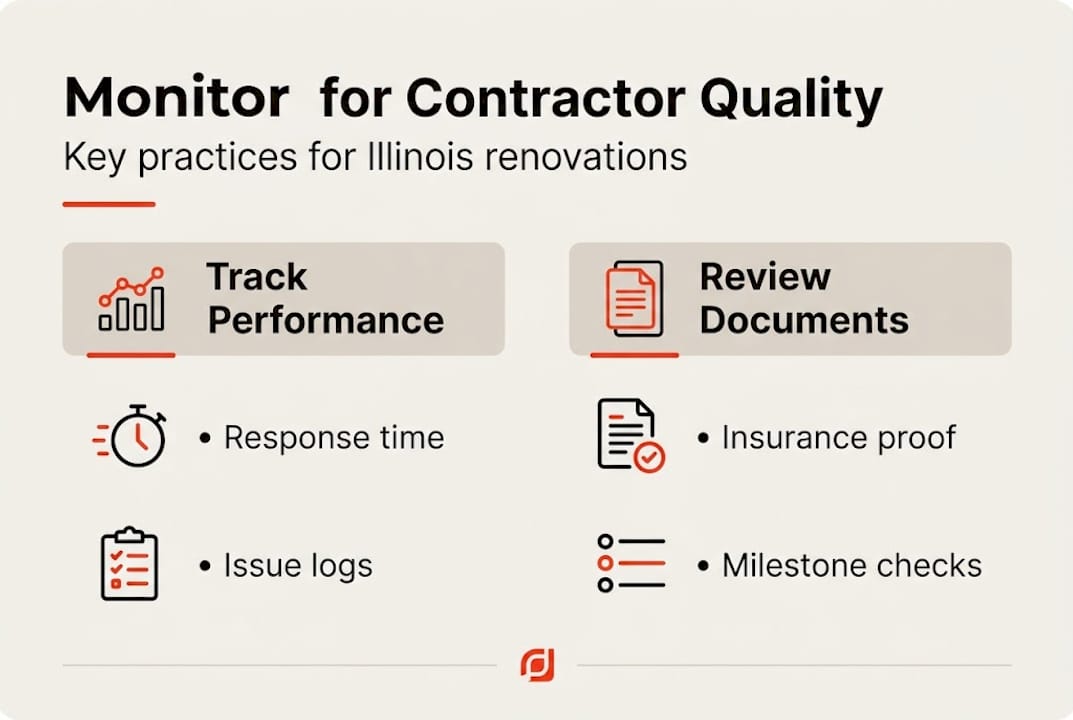
Key performance indicators (KPIs) give you an objective way to measure contractor performance throughout the project. The most relevant KPIs for Illinois renovation projects include:
Contractor performance KPI tracker
| KPI | Benchmark | Tracking method |
|---|---|---|
| Response time to issues | Under 4 hours | Log timestamps in shared project app |
| Milestone completion rate | 90% or above | Weekly progress check against schedule |
| Punch-list closure | Within 5 business days | Written punch-list with sign-off dates |
| Safety compliance | Zero violations | Weekly site walk-through log |
| Material delivery accuracy | 95% correct on first order | Compare delivery receipts to spec sheet |
The 4-hour response benchmark is an industry standard that reflects a contractor’s operational discipline. A contractor who takes two days to respond to a question about materials will take two days to respond to a real problem on site.
Useful tools for monitoring your project include:
- Buildertrend or CoConstruct: Project management platforms designed for contractors and owners to share schedules and documents.
- Google Sheets or Airtable: Lightweight options for tracking milestones and KPIs without a steep learning curve.
- Weekly site visit logs: Simple, handwritten or digital notes from each site visit create a paper trail.
Pro Tip: Document every issue and its resolution in writing. Over time, this record tells you which contractors to rehire and which to avoid. It also protects you if a dispute arises later.
Building contractor credibility into your workflow means treating performance tracking as a normal part of the relationship, not a punishment. Contractors who do great work welcome transparency. Those who resist accountability are often the ones who need it most. Understanding the role of contractors in Illinois commercial build-outs also helps you set appropriate expectations by project type.
Avoid common pitfalls and troubleshoot issues early
Even with a solid contractor and a good monitoring system, problems can surface. The difference between a minor hiccup and a project-derailing crisis usually comes down to how quickly you catch the warning signs.
Watch for these red flags during an active project:
- Contractor stops responding to calls or emails within normal business hours.
- Work is noticeably behind schedule with no explanation or revised timeline offered.
- Subcontractors show up on site who were never mentioned in the original contract.
- Materials delivered do not match the specs you approved in writing.
- The contractor asks for large additional payments before completing agreed milestones.
- Safety equipment is absent or workers are not following basic OSHA protocols.
Vendor vetting via COIs is critical upfront, but so is maintaining those standards throughout the project. A COI that was valid at signing needs to remain valid through project completion.
Compliance issues caught early cost a fraction of what they cost when discovered after the fact. The time to address a permit gap is before the wall is drywalled, not after.
Pro Tip: Set weekly check-ins with your contractor from the start. A 15-minute call every Friday prevents the kind of communication breakdown that lets small problems become expensive ones.
Knowing how to choose local contractors for quality also reduces your risk. Local contractors have reputations to protect in the communities they serve. And if a dispute arises, you have practical recourse that becomes much harder with out-of-state or unlicensed operators. Understanding why licensed contractors matter for Illinois homeowners is one of the most important factors in a successful renovation.
The uncomfortable truth: Quality is a partnership, not just paperwork
Here is what most renovation guides do not tell you. Paperwork is the starting line, not the finish line. We have worked with contractors who had perfect credentials on paper and still delivered disappointing results. We have also seen contractors with modest portfolios exceed expectations because the working relationship was built on clear communication and mutual accountability.
The property owners who consistently get the best outcomes are not just thorough vettors. They are active partners. They show up to site walks. They ask questions without being adversarial. They give feedback early instead of waiting until frustration boils over.
Working with professional contractors who share this mindset is the goal. When both sides treat the project as a shared success, the result reflects that. Quality does not come from a checklist alone. It comes from a culture of honesty, respect, and proactive problem-solving on both sides of the contract.
Take the next step: Trusted Illinois renovation experts
You now have a practical framework for vetting, selecting, and managing contractors for any Illinois renovation project. The next step is putting that framework into action with a team you can trust.

At First Solution IL, our contractors are vetted, our workflows are proven, and our project management process keeps your renovation on schedule and fully compliant with Illinois requirements. Whether you are tackling a residential remodel or a large commercial build-out, our interior renovation guide gives you a clear picture of what to expect at every stage. For commercial projects, our commercial remodeling workflow outlines exactly how we keep complex projects moving efficiently. Reach out today for a free consultation and take the guesswork out of your next renovation.
Frequently asked questions
What licenses must contractors have for Illinois renovations?
In Illinois, specialty licenses are required for plumbing, electrical, and roofing, while general contractors must register locally, particularly through Chicago’s DOB for projects in the city.
How can I verify a contractor’s insurance and credentials?
Ask for their Certificate of Insurance and cross-check licenses through IDFPR or your local authority. COI and license verification is a non-negotiable step before any work begins.
What performance benchmarks are important for contractor quality?
The 4-hour response time benchmark, consistent milestone completion at or above 90%, and fast punch-list closure within five business days are the core indicators to track.
Should I choose local contractors for Illinois renovation projects?
Local contractors understand regional permitting requirements and have community reputations at stake, which typically translates into stronger accountability and better project outcomes.
What are common mistakes in contractor selection for residential and commercial builds?
The most costly mistakes include skipping credential verification, ignoring references, failing to set KPIs after hiring, and assuming verbal agreements are enforceable. COI and KPI tracking prevent most of these errors before they cost you money.