

TL;DR:
- Many Illinois contractors operate without proper licensing or insurance, exposing property owners to significant risks. Verifying credentials such as licenses, insurance, and bonds through official online portals is essential before hiring. Ensuring contractors hold all necessary credentials safeguards your project from legal, financial, and safety issues.
Most Illinois property owners assume the contractor standing in their driveway is licensed and insured. That assumption can be one of the most expensive mistakes you ever make. A 2025 investigation found that a staggering proportion of roofing contractors reviewed in Illinois operated without a valid state license, and enforcement depends largely on the public reporting violations. This guide breaks down what contractor credentials actually mean, why each piece matters to your renovation or construction project, and exactly how to verify them before anyone lifts a hammer.
Table of Contents
- What are contractor credentials and why do they matter?
- Common credential gaps: what can go wrong
- How to verify contractor credentials in Illinois
- Credentials and contracting: insurance, bonding, and compliance explained
- What most Illinois owners overlook about contractor credentials
- Connect with fully credentialed contracting pros in Illinois
- Frequently asked questions
Key Takeaways
| Point | Details |
|---|---|
| Verify credentials | Always check for a valid license, insurance, and bonding before hiring a contractor in Illinois. |
| Risks of gaps | Missing credentials can lead to financial loss, failed inspections, and legal problems for property owners. |
| Use official tools | Rely on official state and city lookup portals to confirm your contractor’s credentials. |
| Credentials protect you | Proper documentation ensures both your project and your financial interests are secure. |
What are contractor credentials and why do they matter?
Contractor credentials are not just pieces of paper hanging on an office wall. They represent a layered system of legal protections that work together to keep your project safe, legal, and financially sound. When you understand each component, evaluating contractor credentials becomes straightforward rather than intimidating.
In Illinois, contractor credentials fall into three main categories: licenses, insurance, and bonding.
A business license confirms that the contractor legally operates as a business entity in Illinois. A trade-specific license goes further, proving that the contractor has passed exams or met experience requirements for work in plumbing, electrical, roofing, and similar specialized fields. General liability insurance protects you if the contractor accidentally damages your property. Workers’ compensation insurance is equally critical because it covers medical costs if a worker is injured on your property, shielding you from personal liability. Bonding (also called a surety bond) provides a financial guarantee that the contractor will fulfill contractual obligations.
A contractor without insurance, even if licensed, can expose property owners to costly lawsuits and out-of-pocket repair bills that no amount of negotiation will recover.
The table below shows each credential type and what it specifically protects:
| Credential type | Why it matters | What it covers |
|---|---|---|
| Business license | Confirms legal operation | Basic legal standing to contract |
| Trade-specific license | Proves technical competency | Compliance with trade standards |
| General liability insurance | Protects your property | Damage caused during work |
| Workers’ compensation insurance | Protects against injury claims | Medical costs for on-site injuries |
| Surety bond | Ensures project completion | Financial losses from contractor default |
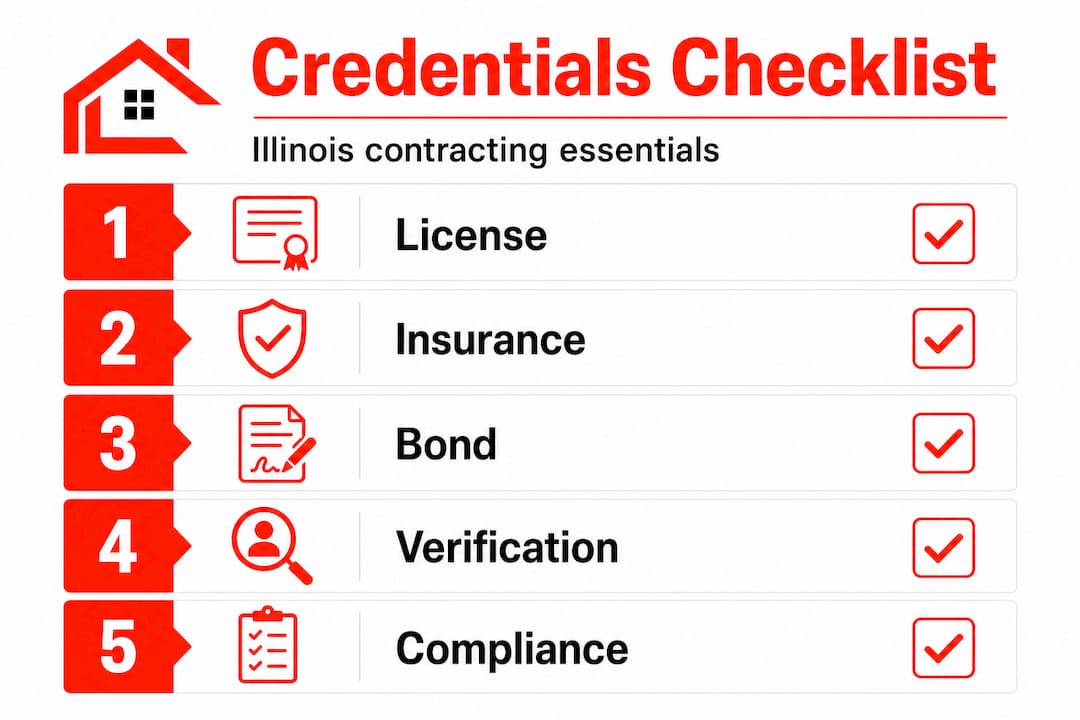
For Illinois projects, here is the typical credential checklist you should request before signing any contract:
- Valid business registration in Illinois
- Trade license issued by the Illinois Department of Financial and Professional Regulation (IDFPR) or the applicable municipality
- Proof of general liability insurance with adequate coverage limits
- Workers’ compensation insurance certificate (required for any contractor employing workers)
- Surety bond documentation, especially for larger scope projects
If you are working on a project in Chicago specifically, the Contractor License Lookup tool maintained by the City of Chicago Department of Buildings lets you confirm a contractor’s local licensing status in minutes. This is especially important because Chicago has city-level requirements that exist separately from statewide IDFPR licensing. As outlined in Illinois contractor insurance and bonding requirements, a contractor typically needs both correct licensing and proper insurance to be fully compliant. One without the other still leaves you exposed.
Understanding the key credential risks involved in Illinois projects helps you prioritize which documents to request first and why each one matters to your specific project type.
Common credential gaps: what can go wrong
Knowing what credentials are is only half the battle. Understanding what happens when those credentials are missing gives you the urgency to act before you are in a difficult situation.
A 2025 roofing investigation found that more than 1,200 out of roughly 1,800 reviewed roofing contractors in Illinois had no valid state license. That is more than two-thirds of reviewed contractors operating outside the law, and enforcement agencies admitted they depend heavily on public complaints to catch violations.
Credential gap consequences at a glance:
| Credential issue | Typical consequence for the owner |
|---|---|
| Unlicensed contractor | Failed permits, project shutdown, legal fines |
| No general liability insurance | Owner pays for accidental property damage |
| No workers’ comp insurance | Owner faces personal injury lawsuits from hurt workers |
| No surety bond | No financial recourse if contractor abandons project |
| Expired or suspended license | City stop-work orders, voided warranties, compliance violations |
Here is what these gaps look like in real Illinois scenarios:
-
Failed inspections. A Chicago homeowner hires an unlicensed contractor for a bathroom renovation. When the city inspector arrives for a required inspection, the work fails because the contractor performed plumbing modifications without a proper trade license. The homeowner must now pay a licensed plumber to re-do the work and apply for corrected permits.
-
Stop-work orders. A commercial property owner in the suburbs approves a structural modification. Midway through the job, the municipality discovers the contractor holds no valid building license. A stop-work order freezes the site. Delays cost thousands per week in lost business revenue while the legal situation is resolved.
-
Injury liability. A worker falls from scaffolding at a residential remodel. The contractor carried no workers’ compensation insurance. The injured worker’s attorney pursues the homeowner for damages because the uninsured contractor cannot cover medical costs. The homeowner’s personal property insurance may not cover the full claim.
-
Denied insurance claims. A homeowner files a property insurance claim after unlicensed electrical work sparks a small fire. The insurer investigates and discovers the work was done without proper permits by an unlicensed electrician. The claim is denied because the work was unpermitted and noncompliant.
-
No recourse after project abandonment. A contractor takes a significant deposit, begins demolition, and then disappears. Because the contractor was never bonded, the homeowner has no financial safety net and must start over from scratch with a new contractor.
The dangers of uninsured contractors go far beyond simple inconvenience. They can derail timelines, drain budgets, and create legal complications that persist long after the dust settles. Understanding these credential-related risks upfront keeps you in a position to make informed choices.
Pro Tip: Always request original documentation directly from the contractor and verify every number with the issuing authority. Do not accept photocopies without cross-checking them through official state or city portals.
How to verify contractor credentials in Illinois
The good news is that Illinois and Chicago make credential verification accessible with free online tools. The process takes less than 30 minutes and can save you enormous headaches down the road. Here is a practical step-by-step method based on how to verify a contractor license in Illinois:
-
Identify your project type. Different trades require different licenses. A kitchen remodel may involve general contractors, plumbers, and electricians. Each trade needs its own verification. Write out the full scope of work before you start checking credentials.
-
Determine the relevant license type. For most trade-specific work in Illinois, the IDFPR issues state licenses. For projects in Chicago, the city’s Department of Buildings maintains a separate licensing system. Know which authority applies to your project before you search.
-
Use official state and city lookup portals. The IDFPR’s online license lookup lets you verify any state-issued professional license by name or license number. For Chicago-specific trade licenses, use the Contractor License Lookup at the City of Chicago Department of Buildings website. Both searches take under five minutes.
-
Validate insurance and bonding directly. Ask the contractor for a current Certificate of Insurance and contact the issuing insurance company directly to confirm the policy is active and the coverage limits meet your project’s needs. For the surety bond, request the bond number and confirm it with the bonding company.
-
Document everything. Save copies of all certificates, license confirmation screens, and any written contractor representations. Store them alongside your contract. If a dispute arises, your documentation makes a substantial difference in how quickly and favorably it resolves.
Using this license verification guide approach provides a repeatable framework you can apply to every contractor you hire. The verifying licenses step is especially important for larger projects where multiple subcontractors may be brought in mid-project.
Pro Tip: If a contractor changes subcontractors or adds new crew members during your project, repeat your credential checks for the new personnel. Compliance at the start does not automatically extend to every worker who steps onto your property later.
Watch for these red flags during the verification process. A contractor who delays providing documentation, claims paperwork is “in the mail,” deflects with vague explanations, or becomes defensive when asked for credentials is signaling a problem. A confident, credentialed professional hands over insurance certificates and license numbers without hesitation. For tips on ensuring contractor quality throughout your project, those red flags matter at every stage, not just at the start.
Credentials and contracting: insurance, bonding, and compliance explained
When property owners think about credentials, they often picture just the license. But insurance and bonding form an equally critical layer of protection that changes how risk is distributed across your project.
General liability insurance covers physical damage that happens to your property during construction or renovation. Say a contractor’s crew accidentally breaks a window, damages a structural wall, or floods a room. Without liability insurance, you are negotiating out of pocket with someone who may have very little to recover from. With insurance, the claim goes through a formal process with a financially capable insurer.
Workers’ compensation insurance addresses a specific and serious risk. Under Illinois law, if an uninsured worker is injured on your property, you as the homeowner or property owner can be held liable. Workers’ comp ensures that injured workers are covered through the contractor’s policy, not through a lawsuit targeting your assets.
Bonding is the protection most people understand the least. A surety bond is a three-party agreement involving the contractor (the principal), you (the obligee), and the bonding company (the surety). If the contractor fails to complete the work, fails to pay subcontractors, or causes financial harm through noncompliance, you can file a claim against the bond. This gives you a real financial remedy rather than an empty legal judgment against a contractor with no assets.
Here is a quick breakdown of what each protection covers and what it does not:
- License: Confirms the contractor has met legal and technical requirements. Does not guarantee quality work or project completion.
- General liability insurance: Covers accidental property damage during the project. Does not cover workers’ injuries or contractor failure to perform.
- Workers’ compensation insurance: Covers medical costs for injured workers. Does not cover property damage or project abandonment.
- Surety bond: Covers financial losses from contractor default or nonperformance. Does not cover accidental property damage or injury.
The Illinois insurance and bonding requirements for contractors make clear that each element plays a distinct role. When one is missing, the entire system has a gap. Missing workers’ comp alone can expose you to a six-figure lawsuit even on a straightforward bathroom remodel.
Credentials are not just paperwork. They actively prevent legal and financial disasters for owners and contractors alike by assigning responsibility, transferring risk, and creating enforceable accountability at every stage of a project.
Understanding how hiring insured contractors changes the risk profile of your project helps you see these requirements not as bureaucratic hurdles but as genuine protective mechanisms.
What most Illinois owners overlook about contractor credentials
Here is an opinion that many in the industry are reluctant to say plainly: credential checks fail most often not because owners are careless, but because they trust the wrong signals.
Someone comes highly recommended by a neighbor. They show up on time, they speak confidently, their quote is reasonable, and their truck looks professional. Every visible cue says “trustworthy contractor.” So the owner skips the paperwork. This is where the real danger lives.
The uncomfortable truth is that credentials do not just confirm a contractor’s competency at the moment of hire. They shape contractor behavior throughout the entire project. A licensed contractor knows that a license board can revoke their ability to work. An insured contractor has an insurer monitoring their claims history. A bonded contractor has a surety relationship that can be terminated for misconduct. These are ongoing accountability mechanisms, not one-time badges.
When a contractor operates without credentials, they have already demonstrated willingness to cut corners on compliance. That same attitude often shows up in material quality, workmanship, and code compliance decisions made when you are not watching. Research consistently supports this, and our own experience at First Solution IL confirms it: the contractors who resist credential verification are often the same ones who produce work that fails inspection.
We also see owners dismiss credential checks for lower-bid contractors. The logic goes: “If something goes wrong, I saved enough to cover it.” That math rarely works. A single injury claim, a permit failure requiring complete re-work, or a project abandonment after a deposit can easily exceed the entire project budget. The licensed contractor impact on reducing renovation defects is measurable and real.
Do not skip credential verification for anyone, regardless of referral source, bid price, or professional appearance. The few minutes it takes to check a license and call an insurer are the cheapest investment in your project.
Connect with fully credentialed contracting pros in Illinois
You now have the knowledge to protect yourself at every stage of hiring a contractor in Illinois. The next step is working with a team that meets every requirement without you having to ask twice.

At First Solution IL, we carry all required credentials for Illinois residential and commercial projects, including licensing, general liability insurance, and workers’ compensation coverage. We believe credential transparency builds the kind of trust that turns a one-time project into a long-term relationship. Whether you are planning a full interior renovation or need help understanding your interior renovation steps before you begin, we can walk you through the process clearly. Our team is also ready to help you understand construction timelines so your project stays on schedule. Reach out today for a free estimate and see what fully credentialed contracting looks like in practice.
Frequently asked questions
How do I check if a contractor has a valid Illinois license?
Use the Contractor License Lookup from the City of Chicago Department of Buildings for Chicago-based trade licenses, or the IDFPR’s online portal for state-issued trade licenses. Both are free and return results in real time.
What insurance should every Illinois contractor have?
General liability and workers’ compensation insurance are standard and required for Illinois contractor compliance. Request current certificates and verify coverage limits are adequate for your project’s scope before signing any contract.
Are unlicensed contractors common in Illinois?
Yes, more than you would expect. A 2025 review found that over 1,200 of roughly 1,800 roofing contractors examined in Illinois had no valid state license, meaning enforcement gaps are significant and owner vigilance is essential.
What’s the difference between a bond and insurance for contractors?
A bond protects you financially if the contractor fails to complete the work or fulfill contractual obligations, while insurance covers accidental property damage or worker injuries during the project. Both are necessary, and having one without the other still leaves meaningful gaps in your protection.