TL;DR:
- Illinois has a layered licensing system with separate state and local credentials for different trades.
- Verifying both state and municipal licenses is essential to avoid legal and financial risks.
- Hiring unlicensed contractors increases the likelihood of project failures, insurance issues, and legal complications.
Most Illinois property owners assume there’s one license that covers every renovation contractor. That assumption is wrong, and it can cost you. Hiring a contractor without the right credentials can trigger failed inspections, denied insurance claims, and expensive do-overs. Illinois runs one of the most layered contractor licensing systems in the country, splitting authority between state agencies and over 1,200 individual municipalities. Understanding how this system actually works isn’t just useful background knowledge. It’s the difference between a renovation that adds value to your property and one that creates legal headaches for years.
Table of Contents
- What renovation licensing means in Illinois
- State and local licensing: Who needs what?
- Illinois Home Repair and Remodeling Act: Legal requirements for homeowners
- Navigating municipal rules: Why local variations matter
- Protecting your investment: How to verify licensing and ensure compliance
- Why skipping licensing shortcuts costs Illinois owners in the long run
- Get expert renovation guidance for your Illinois project
- Frequently asked questions
Key Takeaways
| Point | Details |
|---|---|
| No statewide GC license | Illinois does not issue a single statewide general contractor license—regulations depend on the trade and local municipality. |
| State and local oversight | Trades like roofing and plumbing require state licenses, while general contractors and electricians are regulated locally. |
| Legal contract must-haves | Illinois law requires detailed contracts and specific consumer rights for residential renovation projects over $1,000. |
| Local rules differ | Each Illinois municipality may have unique licensing, registration, or permit rules for renovation contractors. |
| Always verify licenses | Protect your investment by always verifying contractor licensing, insurance, and permits before starting renovations. |
What renovation licensing means in Illinois
Renovation licensing in Illinois doesn’t work the way most people expect. There is no single credential that covers all construction work. Instead, licensing is split between state-regulated trades and locally managed general contracting, which means the rules you follow depend entirely on the type of work being done and where your property sits.
As state licensing requirements confirm, Illinois lacks a statewide GC license; licensing is split by trade and municipality. Compare that to states like California or Florida, where a general contractor must hold a statewide license before touching any residential project. In Illinois, a general contractor in Naperville operates under Naperville’s rules, while one in Rockford follows Rockford’s requirements. These can be very different.
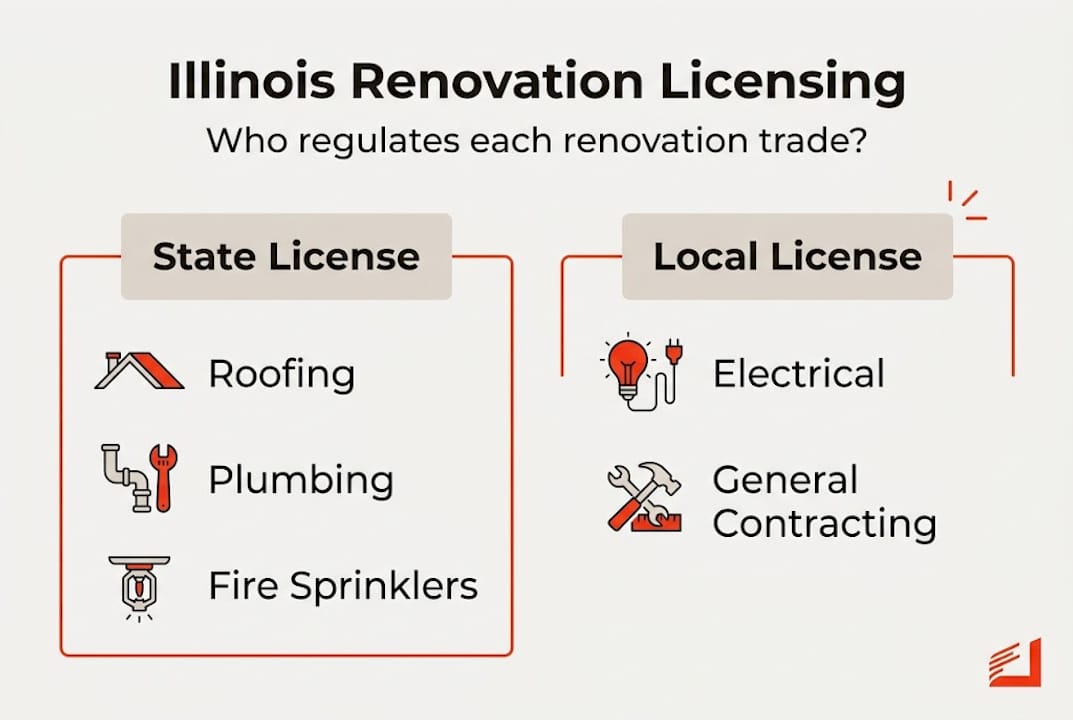
Here’s a quick breakdown of how the structure divides:
| Category | Regulated by | Examples |
|---|---|---|
| Roofing | State (IDFPR) | Residential and commercial roofers |
| Plumbing | State (IDFPR) | All plumbing installations and repairs |
| Fire sprinklers | State | New installs and modifications |
| General contracting | Local municipality | Remodels, additions, renovations |
| Electrical | Local municipality | Wiring, panel work, outlets |
This structure creates real gaps in knowledge for property owners. You might verify that your general contractor is registered in Chicago but overlook whether the plumber they subcontract is state-licensed. Both matter. Both carry separate risks if ignored.
The trades regulated at the state level go through the Illinois Department of Financial and Professional Regulation, commonly called IDFPR. This agency handles licensing exams, renewals, and disciplinary actions. For trades regulated locally, you’ll need to check with your city or village directly.
“Many property owners don’t realize that a contractor licensed in one Illinois city may not be authorized to work in the next town over. Local registration is not transferable.”
For a deeper look at how these standards apply to renovation work specifically, the Illinois renovation standards guide covers what compliance looks like in practice across different project types.
State and local licensing: Who needs what?
Breaking this down further helps you know exactly what to verify before signing any contract. The type of trade determines whether you’re checking state records, local records, or both.
Key licensed trades include roofing, plumbing (state-level), and fire sprinklers, with electrical and general contracting handled locally. Here’s how that maps out in practice:

| Trade | State or local | Responsible agency | Key rule |
|---|---|---|---|
| Roofing | State | IDFPR | Must hold active state license |
| Plumbing | State | IDFPR | License required for all work |
| Fire sprinklers | State | Office of the State Fire Marshal | Separate license for installs |
| Electrical | Local | City/village building dept. | Varies by municipality |
| General contracting | Local | City/village building dept. | Registration or license varies |
Before hiring any contractor, follow these steps for each trade:
- Identify the trade category (state-regulated or locally regulated).
- Search IDFPR’s online license lookup for state trades.
- Contact your local building department for municipal registration requirements.
- Ask the contractor for proof of current licensing, not just a card from two years ago.
- Request a certificate of insurance and verify it directly with the insurer.
For a full walkthrough of how to check credentials, verifying contractor licenses is a practical resource that walks you through each step. And if you’re wondering why this matters beyond paperwork, renovation defects and licensing shows the measurable impact proper licensing has on project outcomes.
Pro Tip: A license alone doesn’t fully protect you. Always ask for proof of general liability insurance and a surety bond. If a contractor hesitates or gives vague answers, treat that as a red flag and move on.
Illinois Home Repair and Remodeling Act: Legal requirements for homeowners
Knowing who should be licensed is only part of the picture. You also have legal rights and responsibilities as an Illinois property owner under state law, specifically under the Illinois Home Repair and Remodeling Act, or HRRA.
The HRRA applies to any residential renovation project valued over $1,000. At that threshold, written contracts, insurance, and consumer rights brochures are all required by law. This isn’t optional paperwork. It’s a legal obligation on the contractor’s part, and knowing it exists gives you real leverage.
Here’s what every HRRA-compliant contract must include:
- Total project cost and payment schedule
- Contractor’s full business name and address
- Estimated start and completion dates
- Description of all work to be performed
- A 3-day right to cancel the contract without penalty
- Proof that the contractor carries liability insurance
You should also receive the state-issued “Home Repair: Know Your Consumer Rights” brochure before work begins. If a contractor doesn’t offer it, ask for it. Its absence is a warning sign.
Pro Tip: Keep a copy of every document you receive before, during, and after your renovation. If a dispute arises, your paper trail is your strongest asset in any legal or insurance proceeding.
Statistic: Projects over $1,000 trigger full HRRA compliance requirements, yet many homeowners never receive the required consumer rights brochure because they don’t know to ask for it.
For more on what your contract should cover, renovation contract basics breaks down each required element. And if you want to understand what protections extend beyond the project itself, the renovation warranty guide covers your post-completion rights.
Navigating municipal rules: Why local variations matter
Even when you understand state requirements perfectly, local rules can catch you off guard. Illinois has over 1,200 municipalities with their own unique licensing and permit rules, and assuming one city’s standards apply everywhere is one of the most common and costly mistakes property owners make.
Chicago is the clearest example. Contractors working in Chicago must register with the Department of Buildings and hold both city and applicable state trade licenses. A contractor registered in Evanston is not automatically cleared to work in Chicago. The documentation requirements, license classes, and inspection schedules are all different.
Here are four of the most common local variations you need to check before any project starts:
- License class requirements: Some municipalities require contractors to hold specific class levels based on project size or type.
- Project value thresholds: Certain cities require permits only above a dollar amount that differs from state thresholds.
- Documentation on file: Some villages require contractors to submit proof of insurance directly to the building department before pulling permits.
- Inspection schedules: Frequency and timing of required inspections vary widely between municipalities.
“A contractor who worked flawlessly on your neighbor’s project in a different suburb may not be registered to work legally at your address. Always verify locally.”
For guidance on what to look for once work begins, inspecting renovation quality gives you a practical framework. If you want to get ahead of local requirements before signing anything, preparing for local rules is a solid starting point.
Protecting your investment: How to verify licensing and ensure compliance
Knowing the rules matters, but applying them is what actually protects your money. Here’s a step-by-step compliance checklist you can use before any renovation project begins.
- Identify the trades involved in your project. List every type of work: plumbing, roofing, electrical, general construction.
- Search IDFPR’s online database for any state-regulated trade. The lookup is free and shows current license status, expiration, and any disciplinary history.
- Contact your local building department to confirm what municipal registration or licensing your general contractor needs.
- Request certificates of insurance and call the insurer directly to confirm the policy is active and covers your project type.
- Ask for copies of recent permits the contractor pulled on comparable projects. A contractor who regularly pulls permits is one who works above board.
- Confirm bonding. A surety bond protects you if the contractor fails to complete the job or causes damage.
As license lookup steps outline, IDFPR lookup and local portals together give you the most complete picture of any contractor’s standing. Don’t rely on just one source.
Pro Tip: If a contractor can’t produce documents within 24 to 48 hours of your request, that’s a red flag. Legitimate licensed contractors keep their credentials organized and accessible because they know clients will ask.
For a complete walkthrough of the verification process, contractor license verification covers every step in plain language.
Why skipping licensing shortcuts costs Illinois owners in the long run
Here’s the uncomfortable reality: some property owners knowingly hire unlicensed contractors because the quote is lower. It feels like a smart financial move in the moment. It almost never is.
Unlicensed work creates a chain of problems that doesn’t show up until later. Insurance companies can deny claims for damage caused by unlicensed contractors. Municipalities can require full demolition and redo of unpermitted work. And when you go to sell the property, buyers’ inspectors find the gaps, which kills deals or forces price reductions that far exceed whatever you saved upfront.
Illinois’ layered licensing system, which many owners see as confusing, actually works in your favor when you use it correctly. Licensed contractors carry exam requirements and continuing education obligations, meaning they stay current on code changes. They also give you legal recourse. If a licensed contractor does poor work, you can file a complaint with IDFPR or the local licensing authority. With an unlicensed contractor, your options are limited to civil court, which is slow and expensive.
The defect reduction stats tell a clear story: proper licensing correlates directly with fewer renovation defects and fewer disputes. The savings from unlicensed labor tend to disappear fast when the first problem surfaces.
Get expert renovation guidance for your Illinois project
Navigating Illinois’ renovation licensing landscape takes time, but you don’t have to figure it out alone. At First Solution IL, we work exclusively with licensed tradespeople and stay current on both state and local requirements across Illinois municipalities.

Whether you’re planning a full interior remodel or a targeted upgrade, our team can walk you through what compliance looks like for your specific project and location. Explore our step-by-step renovation guide to understand the full process, get accurate renovation estimates in Illinois tailored to your scope, or review our remodeling service definitions to find the right fit. Reach out today for a consultation and let us help you move forward with confidence.
Frequently asked questions
Is there a general contractor license in Illinois?
No, Illinois has no statewide GC license; general contracting is regulated at the local level by individual cities and villages.
What renovation trades must be state licensed in Illinois?
Roofing, plumbing, and fire sprinkler contractors require state-issued licenses; most other trades, including electrical and general contracting, are locally regulated.
What must be included in a home renovation contract under Illinois law?
For projects over $1,000, contracts must state the total cost, business address, start and end dates, and include consumer rights information under the HRRA.
How can I verify a contractor’s license in Illinois?
Use IDFPR’s online lookup for state-regulated trades and check with your local municipal building department for complete verification of all required credentials.
Why should I avoid hiring unlicensed contractors?
Unlicensed contractors expose your project to code violations, insurance denials, and costly repairs, with limited legal recourse compared to working with a properly licensed professional.
Recommended
- Illinois contractor license verification guide for property owners
- Illinois Renovation Standards 2026: Essential Compliance Guide
- Renovation Contract Explained: Protecting Illinois Homeowners
- How to prepare for renovations: Illinois homeowner’s guide
- Why Engineers Review Renovations in Texas Homes – Texas Licensed Engineers
- Civil Engineering Basics for Homeowners: Ensure Safe Renovations – Florida Licensed Engineers