
Sorting through estimates for a Chicago kitchen or bathroom remodel can quickly feel overwhelming for Illinois homeowners. Every project brings its own set of variables, shifting costs, and unexpected hurdles that make budgeting more than just a simple math equation. By focusing on a detailed, written estimate with clear inclusions and exclusions, you arm yourself with the information needed to avoid surprises and gain control over renovation expenses.
Table of Contents
- Defining Renovation Estimates For Remodeling Projects
- Types Of Renovation Estimates And Their Accuracy
- What’s Included And Excluded In Estimates
- Evaluating And Comparing Contractor Bids
- Common Mistakes And Costly Misunderstandings
Key Takeaways
| Point | Details |
|---|---|
| Understand Renovation Estimates | Renovation estimates are detailed projections that help homeowners anticipate costs for improvement projects by breaking down expenses across various categories. |
| Types of Estimates | Four main types of renovation estimates vary in accuracy and detail, with definitive estimates being the most precise, typically within 5-10% of actual costs. |
| Inclusions and Exclusions | Homeowners should clarify what is included and excluded in estimates to avoid budget overruns, as common exclusions may involve personal or specialized items. |
| Bid Evaluation | When comparing contractor bids, consider detailed cost breakdowns, contractor credentials, project timelines, and risk management to ensure informed decisions. |
Defining Renovation Estimates for Remodeling Projects
Renovation estimates represent detailed financial projections that help Illinois homeowners understand the potential costs associated with home improvement projects. These projections are not simple price tags but complex calculations that account for multiple variables specific to each unique renovation scenario.
A renovation estimate typically breaks down potential expenses across several critical categories:
- Materials and supplies
- Labor costs
- Demolition and removal expenses
- Potential structural modifications
- Permit and inspection fees
- Contingency budget for unexpected issues
Professional contractors develop these estimates using sophisticated cost prediction models that incorporate early project data and risk assessment techniques. The goal is to provide homeowners with a realistic financial framework that minimizes surprises and helps plan budgets effectively.
Understanding that renovation estimates are dynamic is crucial. These projections evolve as project details become clearer, with initial estimates serving as foundational guidelines rather than fixed final costs. Experienced contractors will typically provide range-based estimates that accommodate potential variables and unexpected challenges.
Pro tip: Always request a detailed, written estimate that breaks down costs by category and includes a clear explanation of potential additional expenses.
Types of Renovation Estimates and Their Accuracy
Renovation estimates are not one-size-fits-all, but rather nuanced financial projections that vary based on project complexity and available information. Modern cost estimation techniques reveal multiple estimate types that help Illinois homeowners make informed decisions about their home improvement projects.
The primary types of renovation estimates include:
- Preliminary Estimates: Rough projections created during initial planning stages
- Conceptual Estimates: More detailed projections based on early project specifications
- Detailed Estimates: Comprehensive breakdowns with precise cost calculations
- Definitive Estimates: Final projections accounting for specific design and material selections
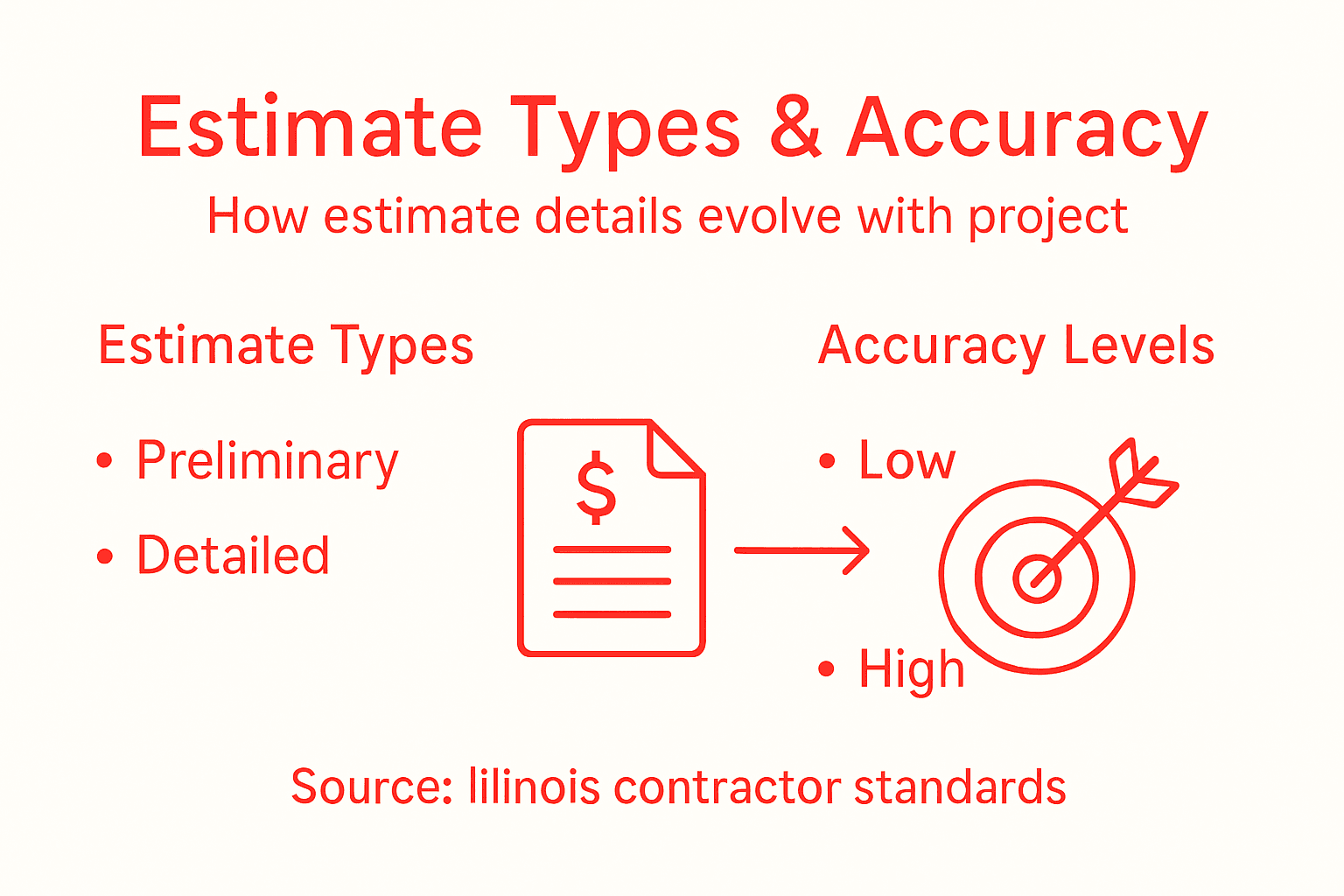
Each estimate type offers different levels of accuracy, with precision increasing as more project details become available. Preliminary estimates might have accuracy ranges of plus or minus 30%, while definitive estimates can narrow that range to within 5-10% of actual project costs.
Here is a quick comparison of renovation estimate types and their accuracy:
| Estimate Type | Planning Stage | Typical Accuracy Range | When to Use |
|---|---|---|---|
| Preliminary | Concept development | ±30% of actual cost | Early project feasibility |
| Conceptual | Initial specification | ±20% of actual cost | Budget planning discussions |
| Detailed | Final design | ±10% of actual cost | Contractor selection phase |
| Definitive | Pre-construction | ±5-10% of actual cost | Before signing contracts |
Accuracy in renovation estimates depends on the clarity of project scope, quality of initial information, and potential for unexpected discoveries during construction.
Contractors use sophisticated data analytics and risk assessment techniques to improve estimate reliability. They consider factors like material costs, labor rates, potential structural challenges, and regional price variations to create increasingly accurate financial projections.

Pro tip: Request estimates from multiple contractors and compare their detailed breakdowns to gain a comprehensive understanding of potential project costs.
What’s Included and Excluded in Estimates
Understanding the specific components of renovation estimates is crucial for Illinois homeowners planning home improvement projects. Comprehensive cost estimation practices reveal a complex landscape of inclusions and exclusions that can significantly impact project budgeting.
Typical inclusions in renovation estimates typically encompass:
- Labor costs for all skilled workers
- Primary construction materials
- Demolition and removal expenses
- Necessary permit and inspection fees
- Basic equipment and tool rentals
- Standard site preparation work
- Temporary project management expenses
Conversely, exclusions often involve elements homeowners might mistakenly assume are covered:
- Personal furnishings and decorative items
- Landscaping modifications
- Specialized custom design work
- Potential structural repairs discovered mid-project
- Upgraded material selections
- Utility connection or modification costs
Not all renovation estimates are created equal. Always request a detailed breakdown that explicitly states what is and is not included in the projected costs.
Professional contractors understand that transparency is key. They typically provide comprehensive documentation explaining each cost component, helping homeowners avoid unexpected financial surprises during renovation projects.
Pro tip: Request a line-item estimate that clearly delineates every included and excluded expense to prevent misunderstandings and budget overruns.
Evaluating and Comparing Contractor Bids
Comparing contractor bids requires a strategic approach that goes beyond simply looking at the bottom-line price. Effective cost estimation strategies emphasize the importance of comprehensive bid analysis to ensure project success.
Key factors to evaluate when comparing contractor bids include:
- Detailed Cost Breakdown
- Line-item pricing
- Material specifications
- Labor cost allocations
- Contractor Credentials
- Years of experience
- Local licensing and insurance
- Professional certifications
- Project Timeline
- Proposed start and completion dates
- Milestone schedules
- Potential flexibility
- Risk Management
- Contingency planning
- Potential additional cost scenarios
- Warranty and guarantee terms
Not all bids are created equal. A low price might signal potential shortcuts or hidden costs that could emerge later in the project.
Homeowners should look beyond the initial price tag and carefully examine the comprehensive value each contractor offers. This means analyzing the depth of their estimate, the clarity of their proposed work, and their demonstrated expertise in handling similar renovation projects.
Professional contractors understand that transparency builds trust. The most comprehensive bids will provide clear explanations of every cost, potential variation, and project parameter, helping homeowners make informed decisions.
Use this table as a reference for evaluating contractor bids:
| Evaluation Factor | Why It Matters | Red Flag to Watch For |
|---|---|---|
| Cost Breakdown | Shows transparency on pricing | Lump-sum or vague pricing |
| Contractor Credentials | Indicates reliability and qualifications | Missing or outdated licenses |
| Project Timeline | Helps with scheduling and planning | Unrealistically short durations |
| Risk Management | Protects against surprises | No contingency plans |
Pro tip: Request at least three detailed bids and create a side-by-side comparison matrix to objectively evaluate each contractor’s proposal.
Common Mistakes and Costly Misunderstandings
Home renovation projects are notorious for unexpected challenges, and understanding potential pitfalls can save Illinois homeowners significant time and money. Common cost estimation errors reveal critical areas where homeowners frequently miscalculate their renovation budgets and expectations.
The most prevalent mistakes include:
- Underestimating Hidden Costs
- Structural damage discovery
- Outdated electrical systems
- Unexpected plumbing issues
- Code compliance upgrades
- Incomplete Project Scoping
- Vague project definitions
- Insufficient material specifications
- Lack of detailed design plans
- Budget Miscalculations
- Inadequate contingency funds
- Overlooking permit expenses
- Failing to account for labor rate fluctuations
- Communication Breakdowns
- Unclear contractor instructions
- Misaligned project expectations
- Inconsistent documentation
Renovation budgets are living documents. Expect surprises and maintain financial flexibility throughout your project.
Homeowners often underestimate the complexity of renovation work. What appears to be a straightforward project can quickly become complicated by underlying structural issues, material availability challenges, or unexpected regulatory requirements. Professional contractors understand these nuances and build contingencies into their planning.
Careful documentation, open communication, and a realistic approach to potential variations can help mitigate most renovation risks. By anticipating potential challenges, homeowners can create more accurate budgets and smoother project experiences.
Pro tip: Always allocate an additional 15-20% of your total budget for unexpected expenses and potential project complications.
Take Control of Your Renovation Budget with First Solution IL
Navigating renovation estimates can feel overwhelming when facing unclear costs and unexpected expenses. Understanding detailed cost breakdowns, inclusive and exclusive items, and comparing contractor bids are key to making confident decisions. At First Solution IL, we specialize in transparent and precise home improvement estimations tailored for Illinois homeowners. Whether you are considering a full remodel or focused updates like a bathroom upgrade or drywall installation, our expert team supports you each step of the way.

Explore our Bathroom Remodeling Archives – First Solution IL or Drywall Archives – First Solution IL to see how clear, detailed planning leads to exceptional results. Don’t let budget uncertainties delay your dreams. Visit First Solution IL now to request your free, comprehensive renovation estimate and start transforming your home with confidence today.
Frequently Asked Questions
What is included in a renovation estimate?
A renovation estimate typically includes labor costs for skilled workers, primary construction materials, demolition and removal expenses, necessary permit and inspection fees, basic equipment rentals, and standard site preparation work.
How can I compare contractor bids effectively?
To compare contractor bids effectively, evaluate detailed cost breakdowns, check contractor credentials, confirm project timelines, and assess risk management strategies. Look for transparency and clarity in each bid.
What are the common mistakes homeowners make with renovation estimates?
Common mistakes include underestimating hidden costs, incomplete project scoping, budget miscalculations, and communication breakdowns. Homeowners should prepare for surprises and maintain flexibility in their budgets.
How accurate are different types of renovation estimates?
Different types of renovation estimates range in accuracy. Preliminary estimates may be within ±30% of actual costs, while definitive estimates can be more precise, often within ±5-10% of actual project expenses.