TL;DR:
- Illinois lacks a statewide residential building code, so local authorities set renovation rules. Chicago uses a tiered alteration system under its own code, unlike other cities. Proper permits, inspections, and licensed contractors are essential to avoid legal and safety issues.
Most homeowners in Illinois assume there’s one clear rulebook for renovation projects. There isn’t. Unlike many other states, Illinois does not enforce a single statewide residential building code, which means the rules governing your kitchen remodel, basement finishing, or roof replacement depend entirely on where you live. This guide breaks down exactly how local code authority works, what Chicago’s unique system means for city property owners, why permits are never just paperwork, and which legal protections apply when you hire a contractor. Whether you’re a first-time renovator or a seasoned property investor, understanding these layers of regulation can save you thousands of dollars and a lot of headaches.
Table of Contents
- Why Illinois has no single building code for renovations
- Decoding local building codes: Chicago versus other Illinois jurisdictions
- Permits, inspections, and the cost of non-compliance
- License, contract, and consumer protection rules you can’t ignore
- The overlooked pitfalls: What most guides won’t tell you
- Take the next step with compliance-ready remodeling
- Frequently asked questions
Key Takeaways
| Point | Details |
|---|---|
| No statewide renovation code | Every Illinois city or village sets its own rules for home renovations—always check locally. |
| Chicago uses unique system | Chicago’s Building Rehabilitation Code has structured levels not seen elsewhere in Illinois. |
| Permits and inspections matter | Skipping compliance puts you at risk for fines, delays, and resale complications. |
| Consumer rights are protected | Illinois law backs up written contracts, licensed contractors, and a three-day cancellation right. |
Why Illinois has no single building code for renovations
Here’s something that surprises most people: Illinois is one of the few states in the country that does not impose a uniform statewide residential building code for renovation work. The state residential code applies only to new construction, not repairs or remodels on existing homes. That responsibility falls to local Authorities Having Jurisdiction, commonly called AHJs.
An AHJ is simply your local governing body, whether that’s a city, village, township, or county. Each one sets its own rules for what renovations require permits, what standards the work must meet, and how inspections are handled. Two houses sitting ten miles apart in different municipalities can be subject to completely different renovation requirements. That’s not a bug in the system. That’s the system.
This matters enormously for Illinois renovation code basics because it means there’s no shortcut. You can’t look up a single state document and assume it covers your project. You need to contact your specific city or village code office before you plan anything, hire anyone, or spend a dollar on materials.
Common pitfalls that catch homeowners off guard include:
- Assuming that because a neighbor got away with unpermitted work, you can too
- Confusing new construction codes with renovation standards
- Believing a contractor’s word that “no permit is needed” without verifying independently
- Overlooking that some municipalities update their adopted codes on different schedules
- Forgetting that condo associations or HOAs may layer additional requirements on top of local codes
“Repairs to existing homes are regulated by local Authorities Having Jurisdiction, not the state residential code, which applies only to new construction.” This is the core reality every Illinois property owner must internalize before planning any renovation.
When preparing for renovations, your very first call should be to your local building department. Ask them directly: what permits are required for your specific scope of work? Get it in writing if you can. This single step protects you from costly surprises later in the project.
Decoding local building codes: Chicago versus other Illinois jurisdictions
Once you understand that each municipality controls its own renovation rules, the next logical question is: how different are they really? The answer is very different, especially when you compare Chicago to the rest of the state.
Chicago operates under its own Building Rehabilitation Code, known as Chapter 14R. This code uses a tiered system called alteration levels to determine what compliance requirements kick in based on the scope of your project. Level 1 covers minor work and focuses on fire protection, egress, and energy efficiency. As your project grows in scope, higher alteration levels trigger progressively more requirements, including structural, accessibility, and mechanical upgrades.
This tiered approach is actually smart design. It prevents a homeowner replacing a bathroom vanity from being held to the same standard as someone gutting and rebuilding an entire floor. But it also means you need to know which level your project falls under before you start, because misclassifying your work can lead to compliance failures mid-project.
Outside Chicago, cities like Springfield, Peoria, and Rockford typically adopt modified versions of the International Building Code or International Residential Code, sometimes with local amendments. Here’s a quick comparison to illustrate the differences:
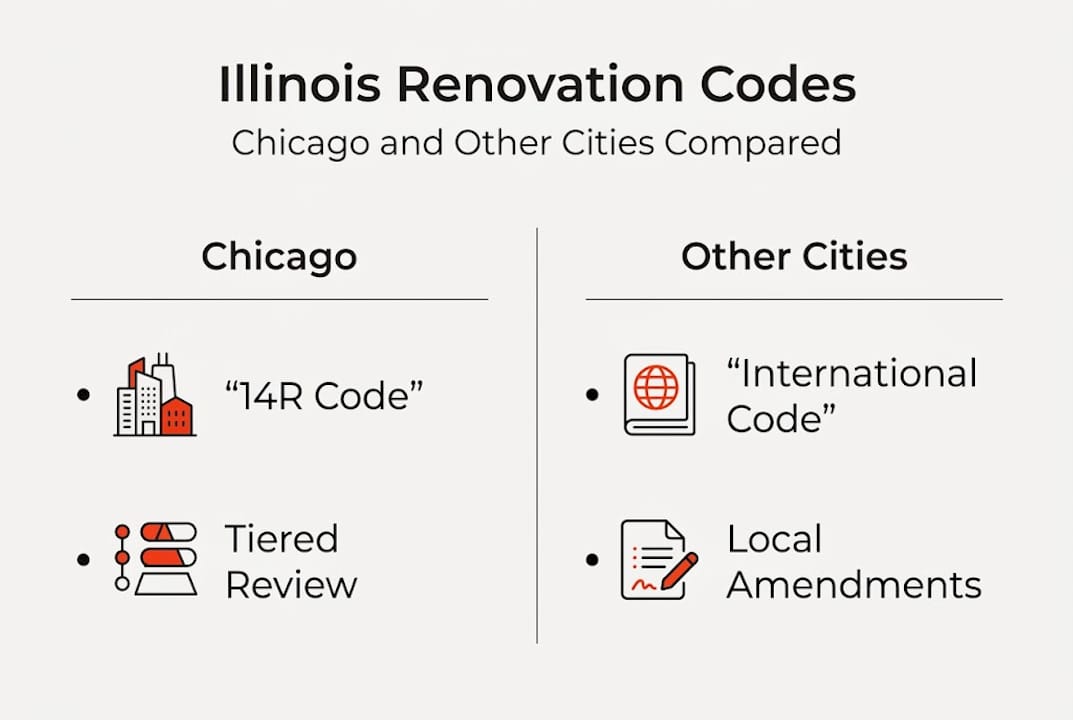
| Factor | Chicago | Springfield/Peoria/Others |
|---|---|---|
| Code system | Building Rehabilitation Code (14R) | Adopted IBC/IRC with local amendments |
| Alteration levels | Yes, Level 1 through Level 3+ | Generally not used |
| Permit process | City of Chicago permit portal | Local municipal office |
| Energy requirements | Chicago Energy Code | Local adoption varies |
| Inspection authority | City inspectors | Local building department |
For renovation quality inspection, this table is more than academic. It tells you that the process of getting approved, inspected, and signed off on your project will look different depending on your location.
Pro Tip: Before planning a renovation, search your municipality’s official website for their building department page. Most post their adopted code version, permit fee schedules, and contact information. If you can’t find it online, call them directly. Ten minutes on the phone can prevent months of problems.
Permits, inspections, and the cost of non-compliance
Permits feel like bureaucratic friction. They’re not. A building permit is the mechanism that puts a licensed inspector between your renovation and a potential safety hazard. It’s also what protects your investment when you eventually sell the property.
Skipping required permits is one of the most expensive mistakes Illinois property owners make. The consequences of non-compliance can include fines, mandatory stop-work orders, forced demolition of completed work, and serious complications during real estate transactions. Buyers and their agents routinely pull permit records. Unpermitted work discovered at closing can kill a sale or force a significant price reduction.

Here’s a general overview of what permit costs and timelines look like for common renovation projects in Illinois:
| Project type | Typical permit cost | Inspection stages | Avg. approval time |
|---|---|---|---|
| Kitchen remodel | $150 to $500 | Rough-in, final | 1 to 3 weeks |
| Bathroom addition | $200 to $600 | Framing, plumbing, final | 2 to 4 weeks |
| Basement finishing | $100 to $400 | Framing, electrical, final | 1 to 3 weeks |
| Roof replacement | $75 to $300 | Final only | 1 to 2 weeks |
| Electrical panel upgrade | $100 to $350 | Rough-in, final | 1 to 2 weeks |
These figures vary by municipality, so always confirm with your local AHJ. To check permit and compliance risks before starting work, follow this process:
- Define your project scope clearly in writing before contacting the building department.
- Call or visit your local AHJ and ask whether a permit is required for your specific work.
- Submit your permit application with required drawings or specifications.
- Schedule your rough-in inspection before covering any structural, electrical, or plumbing work.
- Complete the final inspection and obtain your certificate of occupancy or completion.
Skipping a permit doesn’t make the requirement disappear. It just moves the risk from the building department to you personally, and that risk compounds every year the work sits undisclosed.
One underappreciated benefit of inspections is that they catch contractor errors before they become your permanent problem. An inspector who flags improper wiring during rough-in saves you from a fire hazard hidden inside your walls for decades.
License, contract, and consumer protection rules you can’t ignore
Building codes tell you what the work must look like. Illinois consumer protection law tells you how the business relationship with your contractor must work. Both matter equally.
The Illinois Home Repair and Remodeling Act sets clear requirements for any project over $1,000. Under this law, written contracts are required for jobs exceeding that threshold, and homeowners have a 3-day right to cancel any contract signed at their home. Contractors are also required to provide a consumer rights brochure before work begins. These aren’t optional courtesies. They’re legal obligations.
Here’s what must be covered in any renovation contract:
- Full description of the work to be performed
- Materials to be used, including brands or grades where relevant
- Total price and payment schedule
- Start and estimated completion dates
- Contractor’s name, address, and license number
- Dispute resolution process
For renovation contract protections, the written agreement is your primary defense if a project goes wrong. Never pay in full upfront, and never accept a verbal agreement for significant work.
Certain trades in Illinois require state licensing regardless of which municipality you’re in. Plumbers, electricians, and roofers must hold valid state licenses. You can verify credentials through the Illinois Department of Financial and Professional Regulation. Understanding the licensed contractors’ role in your project is not just about legal compliance. Licensed tradespeople carry insurance, which protects you if something goes wrong.
Pro Tip: Use the contractor license verification process before signing anything. A legitimate contractor will welcome the check. Anyone who resists or deflects is a red flag worth taking seriously.
The overlooked pitfalls: What most guides won’t tell you
After years of working on renovation projects across Illinois, we’ve seen a pattern that no checklist fully captures: most compliance failures don’t happen because homeowners are careless. They happen because people trust the wrong assumption at the wrong moment.
The most dangerous assumption is that your contractor knows the local code. Some do. Many don’t, especially if they work across multiple municipalities with different requirements. We’ve seen projects in the suburbs where a contractor applied Chicago-specific practices that didn’t match local standards, causing inspection failures and costly rework.
Permits also reveal things you didn’t expect to find. Opening walls for a permitted remodel sometimes uncovers outdated wiring, unpermitted previous work, or structural issues that need addressing. This feels like bad news in the moment. It’s actually good news. You’re finding out now, not when a buyer’s inspector finds it during a future sale.
For deeper code compliance understanding, the most important habit is simple: verify everything yourself. Don’t rely solely on your contractor’s interpretation of local rules. A five-minute call to your building department is free. A failed inspection or a resale complication is not.
Take the next step with compliance-ready remodeling
Navigating Illinois building codes, permit requirements, and contractor regulations is genuinely complex. But it doesn’t have to slow down your project when you work with a team that already knows the landscape.

At First Solution IL, we handle Illinois remodeling services with full awareness of local code requirements, permit processes, and inspection standards across municipalities. Our team guides you through every stage, from initial planning to final sign-off, so nothing falls through the cracks. If you want to see how a well-organized project runs from start to finish, explore our step-by-step renovation process and request a free estimate. Compliance doesn’t have to be a burden when the right people are managing it for you.
Frequently asked questions
Do I need a building permit for every renovation in Illinois?
Not every renovation requires a permit, but most significant structural, electrical, or plumbing work does. Always confirm with your local AHJ before starting, since requirements vary by municipality.
What is the Home Repair and Remodeling Act in Illinois?
The Act requires written contracts for any project over $1,000, a 3-day cancellation right for contracts signed at your home, and licensed contractors for trades like plumbing, electrical, and roofing.
What happens if I skip permits during my renovation?
You risk fines, mandatory stop-work orders, and serious complications when selling your property. Unpermitted work discovered during a real estate transaction can derail a sale entirely.
Are building codes the same in Chicago as in other Illinois cities?
No. Chicago uses its own Building Rehabilitation Code with a tiered alteration level system, while most other Illinois cities adopt modified versions of the International Building Code or International Residential Code.