

TL;DR:
- Verify contractors’ licenses, insurance, and disciplinary records for safe hiring.
- Local city or county licensing is often required for general contractors in Illinois.
- Proper contracts and ongoing oversight are crucial to protect your investment.
Hiring the wrong contractor in Illinois can drain your budget, derail your timeline, and leave you fighting for legal remedies you didn’t know you needed. Construction and home improvement ranked #2 for consumer complaints with 2,014 cases in 2025, which means thousands of homeowners already learned this lesson the hard way. Credential checks are not a formality. They are the single most important step you can take before anyone touches your property. This guide walks you through every verification stage, from licenses and insurance to contracts and complaint records, so you can hire with real confidence.
Table of Contents
- Understand Illinois contractor credential basics
- Step 1: Verify all relevant licenses
- Step 2: Confirm insurance and bond coverage
- Step 3: Assess reputation, complaints, and track record
- Step 4: Require written contracts and consumer rights materials
- Why most homeowners still get burned: A contractor verification reality check
- Make contractor checks easy with expert renovation support
- Frequently asked questions
Key Takeaways
| Point | Details |
|---|---|
| No blanket license rule | Illinois regulates trades separately, so always check both state and local requirements for your contractor. |
| Always verify insurance | General liability and workers’ compensation coverage must be current and you should confirm their authenticity. |
| Check complaint history | Review state and local complaint databases before hiring to avoid known problem contractors. |
| Require legal paperwork | Written contracts and consumer rights disclosures are mandatory for jobs over $1,000 and protect you under state law. |
| Credentials aren’t everything | Inspect recent work and remain proactive, as credentials alone can’t guarantee a quality result. |
Understand Illinois contractor credential basics
Illinois has a quirk that surprises most homeowners: there is no statewide general contractor license. That means anyone can legally call themselves a general contractor in Illinois without holding a state-issued credential. What the state does regulate are specific trades. Roofing contractors, plumbers, electricians, and a handful of other specialists must be licensed through the Illinois Department of Financial and Professional Regulation (IDFPR).
The IDFPR is your first stop for any state-regulated trade. You can search active licenses, check expiration dates, and see disciplinary history through the IDFPR License Lookup. Bookmark this tool now. You will use it more than once.
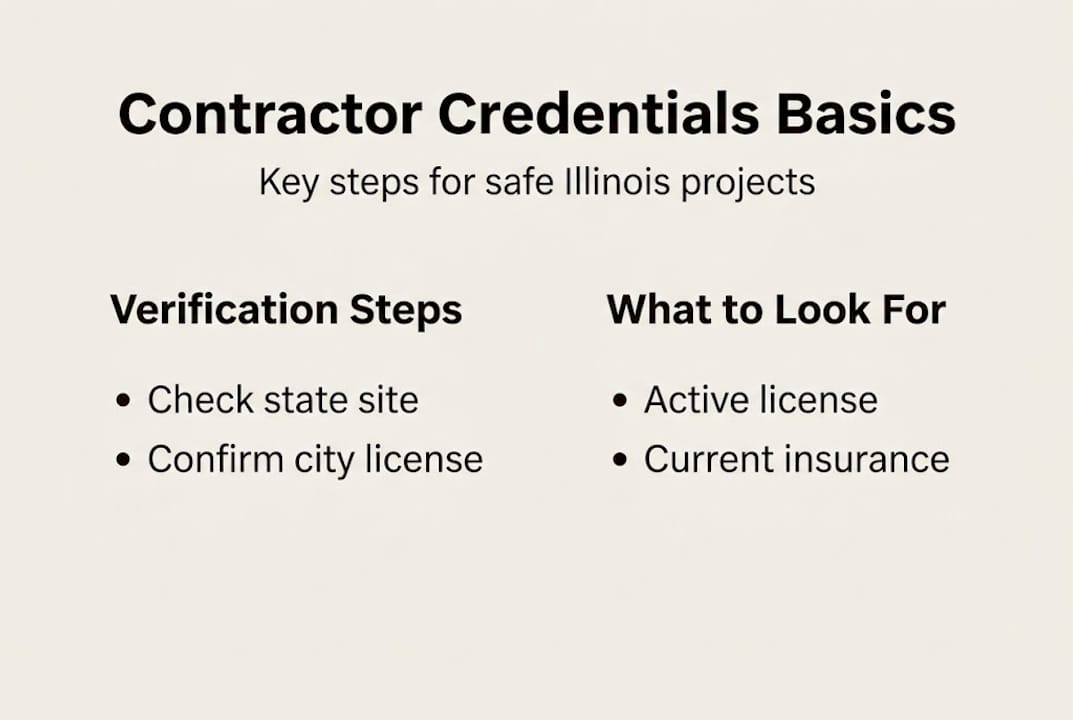
Beyond the state level, local jurisdictions fill the licensing gap for general contractors. Chicago, for example, has its own licensing requirements for general contractors doing work within city limits. Other cities and counties may have similar rules. Before you hire anyone, call your local building department and ask exactly what licenses are required for your project type and location.
Here is a quick overview of how Illinois contractor credentials break down:
| Trade | Licensed By | Verification Source |
|---|---|---|
| General contractor | Local city or county | City/county licensing office |
| Roofer | State (IDFPR) | IDFPR License Lookup |
| Plumber | State (IDFPR) | IDFPR License Lookup |
| Electrician | State (IDFPR) | IDFPR License Lookup |
| HVAC technician | State (IDFPR) | IDFPR License Lookup |
When you start screening candidates, ask for both the contractor’s entity name and the individual license holder’s name. These do not always match, and a missing match is a red flag. Our Illinois license verification guide explains this distinction in detail.
Key credentials to request upfront from any contractor:
- State license number and trade category
- Local contractor license (if your city requires it)
- Proof of registration with the Illinois Secretary of State (for LLCs and corporations)
- Physical business address, not just a phone number
Understanding why this matters is just as important as knowing the steps. The benefits of licensing checks go beyond compliance. They filter out fly-by-night operators who disappear after taking a deposit.
Step 1: Verify all relevant licenses
Understanding what to check is one thing. Knowing exactly how to verify those credentials, step by step, is what separates prepared homeowners from victims of contractor fraud.
Here is how to run a complete license check:
- Identify which trades your project requires. A full kitchen remodel may involve a general contractor, plumber, and electrician. Each needs separate verification.
- Go to the IDFPR License Lookup for state-regulated trades. Search by name and license number. Confirm the license is active, not expired or on probation.
- Check your city’s contractor license portal. Chicago uses its own system separate from the state. Your city may have one too.
- Verify the expiration date. A license that expires mid-project is a liability. Ask for proof of renewal if the date is close.
- Review disciplinary history. IDFPR publishes formal complaints and sanctions. A single old complaint may be minor. A pattern is a serious warning sign.
- Cross-check the entity and individual names. Use official lookup tools like the IDFPR License Lookup for state trades and Chicago’s Contractor License Lookup for city licenses. Both names must match what is on the contract.
Here is what to do with what you find:
| What you see | What it means | Your move |
|---|---|---|
| Active license, clean record | Strong sign | Proceed to insurance check |
| Expired license | Contractor is operating illegally | Do not hire |
| Disciplinary action on file | Possible serious issue | Ask for explanation and documentation |
| No record found | License may be fake or lapsed | Request documentation or walk away |
Our license verification steps page breaks down each lookup portal so you know exactly where to click. Licensed contractors consistently cut renovation defects compared to unlicensed operators, which makes this step worth every minute.
Pro Tip: Always search both the business name and the owner’s personal name. Some contractors license under their own name but operate under a business name. If they do not match on paper, ask why before you go any further.
Step 2: Confirm insurance and bond coverage
Licensing is just the start. Strong insurance is what truly shields you if something goes wrong on your property.
There are two types of coverage every Illinois contractor must carry:
- General liability insurance: Covers property damage or personal injury caused by the contractor’s work. If a worker knocks out your kitchen window or a pipe floods your basement during a renovation, this pays for it.
- Workers’ compensation insurance: Required when the contractor has employees on site. If a worker is injured at your home, workers’ comp covers their medical bills and lost wages. Without it, you could be held financially responsible.
Require proof of both general liability and workers’ compensation, and verify the Certificate of Insurance (COI) is current and lists adequate limits before any work begins.

Reading a COI is simpler than it looks. Check the policy dates, the coverage amounts, and the insurer’s name. Then call the insurance company directly using a number you find independently, not one the contractor gives you, to confirm the policy is active. Fraud does happen. Fake COIs are more common than most homeowners realize.
Typical minimum coverage benchmarks for residential projects in Illinois:
- General liability: $1,000,000 per occurrence
- Workers’ compensation: Statutory limits per Illinois law
- Umbrella or excess liability for larger projects: $1,000,000 and up
A contractor who hesitates or stalls when you ask for insurance documents is telling you something important. Legitimate professionals keep this paperwork ready because they carry it for every job.
Our page on insurance risks in Illinois walks through the scenarios where gaps in coverage have cost homeowners tens of thousands of dollars.
Pro Tip: Ask to be listed as a certificate holder on the contractor’s COI. This means you receive direct notice if the policy is canceled or lapses during your project.
Step 3: Assess reputation, complaints, and track record
Even fully insured and licensed contractors can have red flags buried in their track record. Credentials verify what a contractor is allowed to do. Reputation tells you what they actually do.
Here is how to build a clear picture of any contractor’s history:
- Search the Illinois Attorney General’s consumer protection portal. The AG’s office tracks construction and home improvement complaints, which ranked #2 with 2,014 cases in 2025. The AG recovered $9.4 million for consumers that year.
- Check the Better Business Bureau (BBB). Look at the complaint count, the type of complaints, and how the contractor responded. Unanswered complaints are a serious red flag.
- Pull IDFPR disciplinary records. Any formal action against a license is publicly available. Look for patterns, not just individual incidents.
- Ask for at least three references. Call them. Ask about timelines, cleanup, communication, and whether the final price matched the estimate.
- Search Google and Yelp reviews. Look for patterns in negative reviews, especially mentions of deposits not returned, work left unfinished, or no-shows after payment.
A single bad review does not disqualify a contractor. A pattern of the same complaint, especially around money, is a dealbreaker. The key credential risks page details what patterns to watch for and how to interpret mixed records fairly.
One figure worth keeping front of mind: 2,014 construction and home improvement complaints were filed with the Illinois AG in 2025 alone. That is not a rare edge case. That is a systemic problem that careful screening can help you avoid.
Step 4: Require written contracts and consumer rights materials
Credentials are only half the story. Proper paperwork makes your protections enforceable in court, not just on paper.
Under Illinois law, projects over $1,000 require a written contract that includes the total cost, a description of all materials, start and end dates, a payment schedule, and the contractor’s business address. The contractor must also provide you with the Home Repair: Know Your Consumer Rights brochure. Failure to provide either can void the contract or expose the contractor to fines.
Here is what every contract must include:
- Full legal name and business address of the contractor
- Total price with a clear payment schedule (no more than one-third upfront is a common and reasonable guideline)
- Detailed scope of work and materials, including brand names and grades when relevant
- Project start and estimated completion dates
- Change order process in writing
- Warranty terms for labor and materials
Additional items to confirm are in your contract:
- Lien waiver provision to protect against subcontractor disputes
- Dispute resolution process
- What happens if the project runs over schedule or over budget
- Signed and dated by both parties
Our contract protections guide gives you a checklist you can bring to your pre-signing review. You may also want to review renovation warranty info so you know exactly what to negotiate before work begins.
Never pay in full upfront. Never pay cash without a receipt. Never let a contractor start without a signed contract in your hands.
Why most homeowners still get burned: A contractor verification reality check
Here is something most contractor advice skips: credentials are a filter, not a guarantee. We have seen homeowners follow every step above and still end up with substandard work. Why? Because they verified who signed the contract, not who actually showed up to work.
The licensed contractor you hired may subcontract part or all of your project to workers who are not licensed, not insured, and not accountable to you. Ask directly who will be on site every day and what their credentials are. Request that any subcontractors be listed in your contract.
Another overlooked move: visit one of the contractor’s jobs currently in progress. Call a recent reference and ask if you can see the work mid-project. Most homeowners only check finished results. Seeing how a crew operates under real conditions tells you far more.
After the project wraps, consider a quality inspection from an independent third party. This is especially valuable for major renovations involving structural, electrical, or plumbing work. Catching defects within your warranty window is much easier than fighting for repairs six months later.
Paperwork protects you only if you enforce it. Stay engaged throughout the project.
Make contractor checks easy with expert renovation support
Verifying contractor credentials in Illinois is a process with real consequences if you skip steps. First Solution IL has built resources specifically for homeowners navigating this process, from understanding local licensing to reviewing contracts before you sign.

Our step-by-step interior renovation guide walks through every phase of a project so nothing catches you off guard. If you are still in the planning stage, our Illinois renovation estimates resource helps you benchmark costs and spot bids that are suspiciously low. When you are ready to work with a contractor you can trust, the First Solution IL experts team is available to help you protect your investment from day one.
Frequently asked questions
Do I need to hire a licensed general contractor in Illinois?
Illinois lacks a statewide general contractor license, but local cities often require one. Always check with your city or county building department before signing any contract.
What insurance should an Illinois contractor provide?
They must provide proof of general liability and workers’ compensation insurance. Ask for the Certificate of Insurance and call the insurer directly to confirm the policy is currently active.
What paperwork is required for home repairs over $1,000?
A written contract covering all project details and the Home Repair: Know Your Consumer Rights brochure must be provided under Illinois law for projects over $1,000. Missing either item can void the contract.
How can I check if a contractor has complaints in Illinois?
Search the Illinois Attorney General, BBB, and IDFPR for complaint and disciplinary records. Construction and home improvement was #2 in the AG’s 2025 complaint rankings, so checking these sources before hiring is essential.