TL;DR:
- Strategic, data-driven cosmetic updates increase sale price and reduce time on market in Illinois.
- Exterior improvements like siding, doors, and landscaping offer high ROI for Illinois sellers.
- Most effective renovations are neutral paint, updated flooring, and minor kitchen updates.
Some Illinois homes sell for $12,000 over asking price after just $3,000 in targeted updates. That’s not luck. That’s strategy. Many homeowners believe they need a full kitchen gut or a brand-new bathroom to compete in the market, but the evidence consistently tells a different story. The right upgrades, chosen based on data rather than gut instinct, can shorten your time on market, widen your buyer pool, and dramatically improve your final sale price. This guide breaks down exactly what works for Illinois sellers, what to skip, and how to build a renovation plan that pays off.
Table of Contents
- The value of renovating before selling: Evidence and impact
- High-ROI renovation projects: What works in Illinois
- How much should you spend? Setting a renovation budget
- When not to renovate: Important exceptions and as-is scenarios
- Choosing renovations buyers actually value in Illinois
- The reality most homeowners miss about selling in Illinois
- Ready to renovate smart? Take the next step for your Illinois home sale
- Frequently asked questions
Key Takeaways
| Point | Details |
|---|---|
| Cosmetic updates win | Simple fixes like paint and door replacement offer the highest return for Illinois sellers. |
| Budget carefully | Spend 1–3% of your home’s value on updates to maximize resale without overinvesting. |
| Exterior matters most | Exterior improvements consistently attract more buyers and higher offers. |
| Know when to skip | Sometimes selling as-is is smarter than overhauling a home, especially with time constraints or major issues. |
| Appeal to buyers | Focus on broad appeal—neutral colors, cleanliness, and efficient updates buyers value in Illinois. |
The value of renovating before selling: Evidence and impact
Strategic renovations are one of the most reliable tools a seller has. High-ROI cosmetic updates like fresh paint, curb appeal improvements, and minor kitchen refreshes consistently increase market value, reduce days on market (DOM), and attract more buyers across Illinois. The reasoning is simple: buyers form strong first impressions fast, and a home that looks clean, updated, and move-in ready signals less risk and less effort on their part.
The numbers back this up. Updated homes sell faster, trigger bidding wars more often, and appeal to a much broader pool of buyers, from first-time families to seasoned investors. When a home feels ready to live in, buyers are more emotionally engaged and more willing to compete. That $3,000 investment in paint, fixtures, and landscaping can produce $12,000 above asking. That’s a 4x return in a single transaction.
Here’s a quick look at what targeted updates can do for you:
| Renovation type | Typical cost | Typical value added | Buyer impact |
|---|---|---|---|
| Fresh interior paint | $1,500–$3,500 | $3,000–$7,000 | High |
| Curb appeal / landscaping | $500–$2,000 | $2,000–$5,000 | Very High |
| Minor kitchen updates | $2,000–$7,000 | $5,000–$15,000 | High |
| Garage door replacement | $1,000–$2,500 | $2,500–$5,000 | High |
| Hardwood floor refinishing | $1,000–$3,000 | $3,000–$8,000 | High |
The updates that consistently outperform are not the glamorous ones. They are the ones that remove buyer objections before they even arise.
“When a buyer walks into a home that smells clean, looks bright, and doesn’t have a mental to-do list attached to it, they make decisions faster and offer more. It’s psychology as much as it is property.”
For a deeper breakdown of what drives the best results, our remodeling ROI guide walks through Illinois-specific return data for most common project types.
High-ROI renovation projects: What works in Illinois
With the evidence in mind, let’s break down exactly which improvements give Illinois homeowners the strongest returns for each renovation dollar spent.
Not all renovations are created equal. The 2025 Cost vs. Value Report from Zonda shows garage door replacement leads the pack nationally at 267.7% ROI, followed by steel entry door replacement at 216.4%, manufactured stone veneer at 207.9%, and minor kitchen remodels at 112.9%. A consistent theme stands out: exterior projects outperform interior renovations in almost every category.
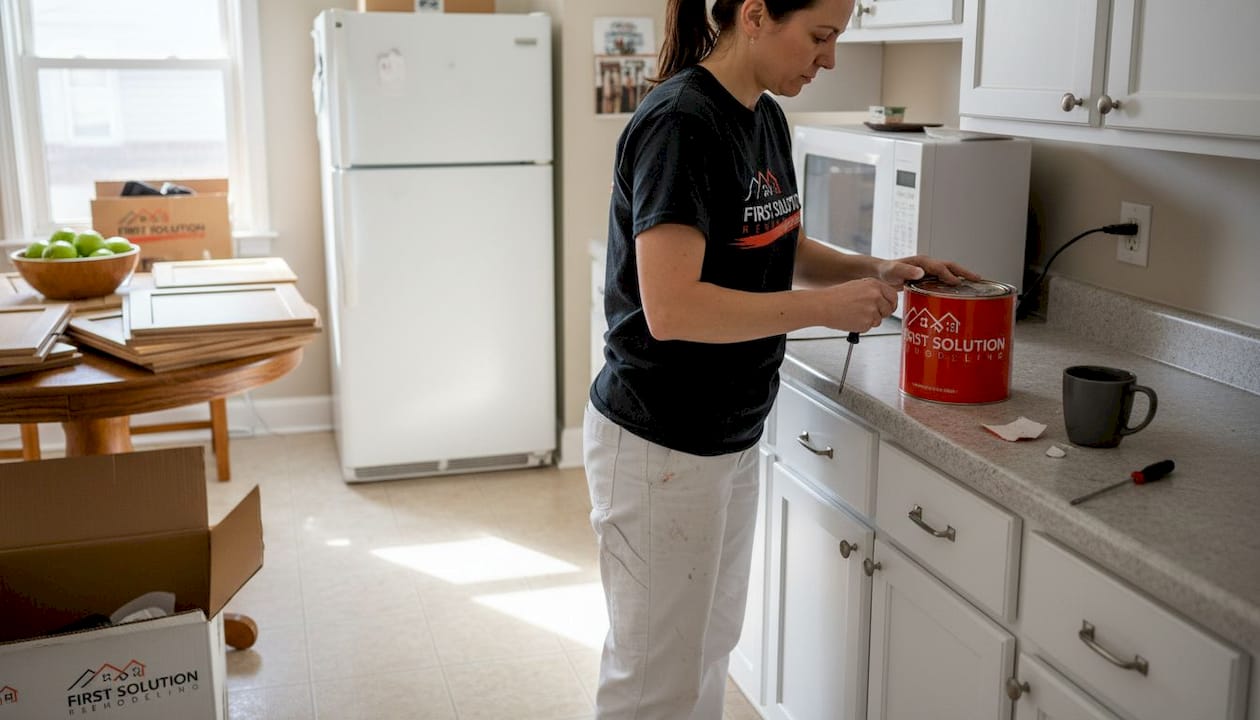
For Illinois and the Chicago metro specifically, the picture sharpens even more. Local data confirms that minor kitchen updates return 75–95% of cost, fresh paint can return up to 100%, garage doors can return up to 100%, and refinishing hardwood floors delivers a remarkable 147% return in many markets. These numbers reflect what Illinois buyers actually respond to.
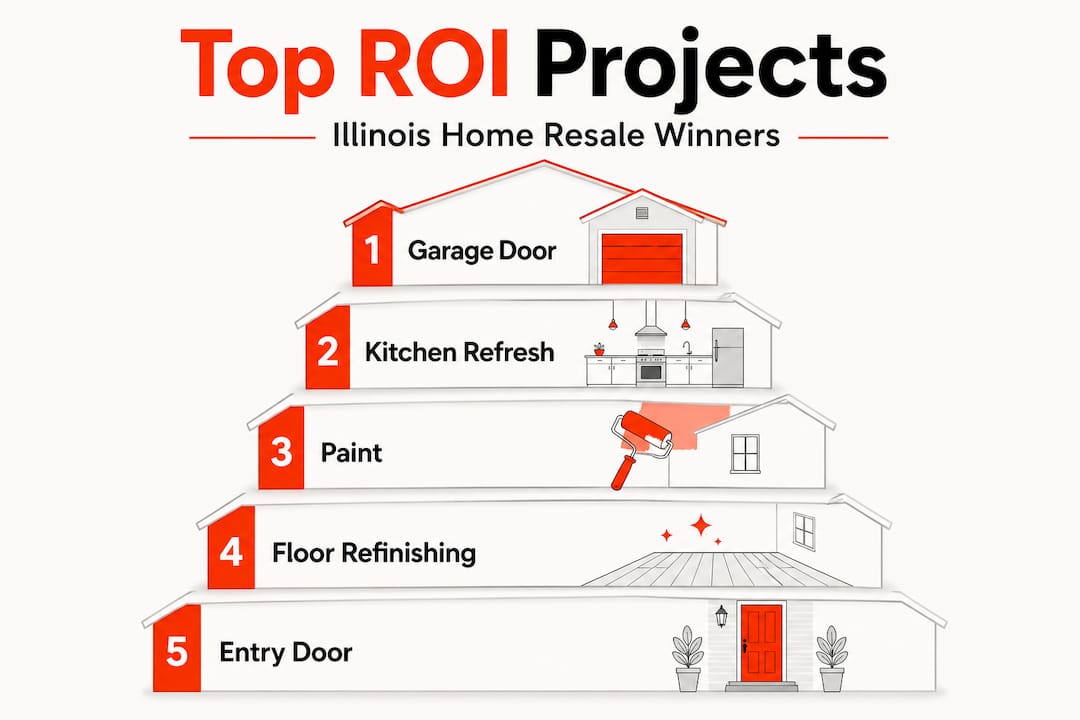
Here’s a side-by-side comparison of popular projects:
| Project | National ROI (2025) | Illinois ROI estimate | Priority level |
|---|---|---|---|
| Garage door replacement | 267.7% | Up to 100% | Very High |
| Steel entry door replacement | 216.4% | High | Very High |
| Minor kitchen remodel | 112.9% | 75–95% | High |
| Hardwood floor refinishing | Varies | Up to 147% | Very High |
| Fresh interior paint | Varies | Up to 100% | Essential |
| Manufactured stone veneer | 207.9% | Moderate | Medium |
| Luxury kitchen remodel | Low | Below cost | Avoid |
The pattern here is unmistakable. Mid-range improvements beat luxury renovations every single time in pre-sale scenarios. Why? Because buyers in most Illinois neighborhoods have a ceiling price they’re willing to pay. If your house is in a $350,000 to $450,000 neighborhood, installing a $60,000 chef’s kitchen won’t push your sale price to $500,000. It will just reduce your profit margin.
The best projects to prioritize before listing:
- Fresh interior paint in neutral tones (greige, white, soft gray)
- Garage door replacement or refinishing
- New steel or fiberglass entry door
- Minor kitchen update (new hardware, lighting, paint, countertop resurfacing)
- Hardwood floor refinishing where applicable
- Landscaping cleanup and mulching for curb appeal
- Updated light fixtures throughout main living spaces
The exterior remodeling benefits for Illinois sellers are especially strong because buyers make their first judgment before they even step inside. A fresh door and clean landscaping set a tone that colors every other impression during a showing.
Pro Tip: Before investing in any single upgrade, check what comparable homes in your neighborhood look like. If every comp has updated kitchens and yours doesn’t, that’s a signal. If they all have the same 1990s finishes, a minor refresh will make you the standout without overspending.
For more inspiration, browse our top remodeling ideas for value or our dedicated kitchen remodeling value breakdown to see how Illinois homeowners are positioning their properties before listing.
How much should you spend? Setting a renovation budget
Knowing which projects deliver the best ROI is essential, but determining how much to invest is just as critical. Let’s set a budget that makes sense for your goals.
The most widely used rule of thumb is straightforward: spend 1–3% of your home’s value on pre-sale renovations. For a $400,000 Illinois home, that translates to roughly $4,000 to $12,000 in updates. This range keeps you in safe territory without risking overcapitalization, which is the point where you’ve spent more than you’ll ever recover in the final sale price.
Here’s a simple framework for building your renovation budget:
- Start with a home inspection. Know what’s broken or dated before you spend a dollar. This tells you where buyer objections will form.
- Get three quotes for each project. Don’t rely on estimates from memory or outdated assumptions. Costs vary significantly across Illinois counties.
- Compare against your neighborhood comps. Pull recent sales data for your zip code and note what updated homes sold for versus original condition homes.
- Rank projects by ROI, not by your personal preference. The goal is to appeal to buyers, not to satisfy your own taste.
- Set a hard cap. Decide in advance how much you’re willing to spend and stick to it. Pre-sale renovation budgets have a way of expanding.
Avoid overcapitalization. This happens when total renovation spending exceeds 30% of the home’s current value. A $200,000 home that receives $80,000 in renovations rarely sells for $280,000. The neighborhood simply won’t support it. Every Illinois market has a ceiling.
Key figure: For a $400,000 home, your renovation budget sweet spot is $4,000 to $12,000. Stay in that range and focus on high-visibility updates.
For cost-saving strategies that help you get more done without overextending, check out our cost-saving renovation tips. And if you’re starting from scratch with planning, our guide on preparing for renovations walks you through the logistics step by step.
Pro Tip: Allocate at least 20% of your budget as a contingency. Once work begins on an older Illinois home, unexpected issues like aging plumbing connections or outdated wiring often surface. A buffer protects your timeline and your bottom line.
When not to renovate: Important exceptions and as-is scenarios
Even the best advice has exceptions. Here’s how to recognize special cases where “less is more” before selling.
Some Illinois sellers are better off listing their home as-is than investing time and money in renovations. These scenarios are specific: strong seller’s markets where inventory is so low that buyers have limited options and will accept dated homes, situations involving major structural problems that would cost more to fix than they’d return, and tight timelines where there simply isn’t time to complete work before listing.
Signs that renovating before sale may not make sense for you:
- Your neighborhood has a very low supply of homes and buyers are competing aggressively
- The home has major foundation, roof, or structural issues that would far exceed the 1–3% budget guideline
- You need to close and move within 30 to 60 days
- The home will likely appeal to investors or house-flippers who prefer to renovate themselves
- Your target buyer pool is developers looking for teardown potential
“In a balanced market, a light touch can mean the difference between a quick sale and months of sitting. But in a hot market, an as-is listing can move just as fast and spare you the renovation stress entirely.”
For dated but structurally sound homes, the best approach is often targeted cosmetic work rather than anything structural. Focus on first impressions: exterior paint, the entry door, and interior cleanliness. These require minimal time and budget while still shifting buyer perception.
Understanding when exterior ROI makes sense for your specific market conditions helps you avoid the trap of renovating a home that would have sold just as well with a deep clean and a coat of paint.
Choosing renovations buyers actually value in Illinois
Once you know your limits and exceptions, you’ll want to target improvements with the most buyer appeal. Here’s what local buyers actually want when comparing Illinois homes.
The research is consistent. Buyers prioritize perceived value over personal taste, and that means neutral colors, energy-efficient features, and move-in ready condition almost always outperform customized or taste-specific upgrades. A bold accent wall might reflect your style, but a soft greige or warm white appeals to the widest group of buyers and photographs better for online listings.
The 2025 NARI Remodeling Impact data confirms this directly. Realtors most commonly recommend painting the entire home (50%), painting one room (41%), and new roofing (37%) as the top three projects before listing. These aren’t glamorous upgrades. They’re foundational ones.
For Illinois buyers specifically, functional improvements carry extra weight:
- Roofs and basements. Illinois winters are harsh. Buyers scrutinize these two areas heavily, and a sound roof or a dry, clean basement can remove a major negotiation lever from a buyer’s hand.
- Neutral interior paint throughout. Buyers mentally furnish and decorate the home during a showing. Neutral walls make that easy.
- Energy-efficient windows and doors. Rising utility costs make efficiency a selling point, especially in the Chicago area.
- Clean, updated flooring. Worn carpet is one of the first things buyers want credited in a negotiation. Refinishing hardwood or replacing carpet with luxury vinyl plank removes that objection entirely.
- Staged or decluttered spaces. Buyers struggle to see past clutter. Professional staging or even a thorough decluttering session consistently improves showing outcomes.
For a full breakdown by project type and how each one moves the needle for Illinois sellers, see our guide on types of property renovations.
The reality most homeowners miss about selling in Illinois
After years of working with Illinois homeowners on pre-sale projects, one pattern repeats itself more than any other: sellers either do too much or too little, and both directions cost money.
The “too much” mistake usually comes from emotion. You’ve lived in this home, raised kids in it, poured your personality into it. It feels like it deserves the best. But buyers aren’t buying your memories. They’re buying a product, and the product needs to match what the neighborhood will support. Installing a $40,000 primary bath in a $320,000 neighborhood is not an investment. It’s a sunk cost dressed up as one.
The “too little” mistake comes from denial or from not understanding that buyers operate on emotion and first impression. A home with peeling trim, scuffed walls, and a broken garage door will get lower offers, sit longer, and attract fewer buyers, even if everything inside is functionally sound.
The surprising reality is that the “wow factor” buyers respond to is almost never expensive. It’s the smell of a clean home. It’s a freshly painted front door in a bold but classic color. It’s walking through a room with consistent, updated light fixtures and thinking, “Someone took care of this place.” These signals cost hundreds, not thousands, and they influence offers as powerfully as any major renovation.
Our honest advice: treat your home like a product going to market, not a personal sanctuary. That mental shift changes every decision you make about where to spend and where to stop. Working with a professional contractor who understands the Illinois market adds a layer of objective perspective that’s hard to get from your own judgment when the home is deeply personal. Learn more about the professional remodeling advantages that keep Illinois sellers from making costly mistakes.
Ready to renovate smart? Take the next step for your Illinois home sale
Selling your Illinois home for the highest possible price doesn’t require gutting every room. It requires knowing which upgrades matter, how much to spend, and what buyers in your specific market are actually looking for.
At First Solution IL, we help Illinois homeowners make data-backed renovation decisions before they list. Whether you’re considering fresh paint and flooring or a full exterior upgrade, our team provides honest assessments and skilled craftsmanship that translate directly into better sale outcomes. Start with our step-by-step interior renovation guide to plan your project, request a personalized estimate through our renovation estimates for Illinois homes page, or explore the full range of our renovation services to find the right solution for your timeline and budget. Your sale price is built before you list.
Frequently asked questions
What renovations add the most value before selling in Illinois?
Garage door replacement, fresh paint, a minor kitchen remodel, and refinishing hardwood floors deliver the highest ROI for Illinois sellers, with hardwood refinishing returning up to 147% in many Illinois markets.
How much should I spend on renovations before selling my home?
Experts suggest budgeting 1–3% of your home’s value on pre-sale updates. For a $400,000 home, that means roughly $4,000 to $12,000 in targeted improvements.
Should I renovate or sell my home as-is in Illinois?
Sell as-is if you’re in a strong seller’s market, dealing with major structural issues, or facing a tight deadline. In most other cases, targeted cosmetic updates will return more than you spend.
What renovations are most appealing to Illinois buyers?
Illinois buyers respond most strongly to neutral paint throughout, updated flooring, energy-efficient features, and a clean roof and basement. Buyers prioritize perceived value over custom upgrades and respond best to move-in ready condition.