

TL;DR:
- Prioritizing indoor environmental quality boosts office productivity significantly.
- Modular, phased renovations minimize disruption and maintain operational efficiency.
- Effective communication and team culture are crucial for realizing renovation productivity gains.
Most property owners in Illinois think of renovation as a visual upgrade. New floors, fresh paint, modern fixtures. But office renovations prioritizing IEQ rank highest for health and productivity impacts, which means the choices you make during a remodel can directly affect how much work gets done inside your building. That’s a fundamentally different way to think about renovation budgets. Instead of asking “What will look better?” you should be asking “What will perform better?” This article breaks down the research, the strategies, and the common mistakes so you can renovate with measurable results in mind, not just aesthetics.
Table of Contents
- Why renovation impacts productivity: The science and evidence
- Commercial renovation strategies to maximize workplace productivity
- Residential renovations: Enhancing comfort, function, and home productivity
- Avoiding productivity pitfalls: Common mistakes and overlooked factors
- The hidden value of renovation: What most Illinois owners overlook
- Ready to boost your property’s productivity?
- Frequently asked questions
Key Takeaways
| Point | Details |
|---|---|
| Design for productivity | Renovating for air quality, thermal comfort, and smart layouts leads to measurable productivity gains. |
| Flexible spaces matter | Modular designs and phased renovations keep both work and upgrades running smoothly. |
| Home upgrades boost daily life | Illinois homeowners see significant gains in home function and satisfaction after renovations. |
| Collaboration drives impact | Leadership and collaboration before, during, and after renovations maximize results and avoid pitfalls. |
Why renovation impacts productivity: The science and evidence
The term indoor environmental quality (IEQ) refers to the conditions inside a building that affect occupant health and performance. It covers air quality, thermal comfort, lighting, acoustics, and spatial layout. Most property owners have heard of these factors in passing, but few realize just how much they move the needle on productivity.
IEQ-centric renovations lead to substantial productivity improvements, with some studies pointing to gains as high as 39.2% in office environments. That’s not a rounding error. That’s the difference between a team that finishes projects on time and one that constantly falls behind.
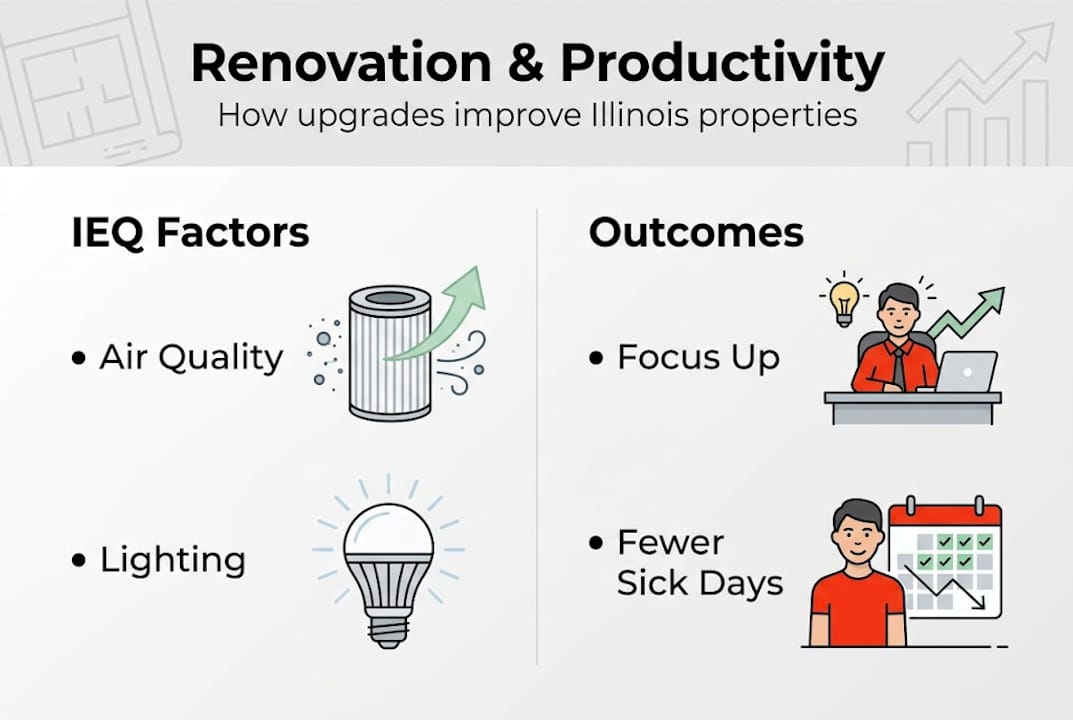
Here’s a breakdown of the key IEQ factors and their impact:
| IEQ Factor | Productivity Impact | Renovation Action |
|---|---|---|
| Air quality | Reduces fatigue and errors | Better ventilation, low-VOC materials |
| Thermal comfort | Improves focus | HVAC upgrades, insulation |
| Lighting | Reduces eye strain | Natural light access, LED systems |
| Acoustics | Lowers distraction | Sound-absorbing panels, layout changes |
| Spatial layout | Supports workflow | Modular, flexible configurations |
One surprising finding: the materials you choose matter beyond aesthetics. Timber-rich environments boost perceived productivity with a moderate effect size compared to concrete-heavy spaces. Timber reduces stress responses and creates a calmer visual environment. If you’re renovating an office in Illinois, this is a detail worth discussing with your contractor.
“The built environment is not a passive backdrop. It actively shapes how people think, feel, and perform every single day.”
For residential properties, the same IEQ principles apply. A home with poor ventilation, uncomfortable temperatures, or cramped layouts creates friction in daily life. That friction adds up. Keeping up with Illinois office renovation trends shows that more property owners are now prioritizing function alongside form, and the results are showing up in measurable ways.
Understanding the full range of types of office renovations also helps you match the right strategy to your specific goals, whether that’s reducing noise, improving airflow, or reconfiguring traffic flow through your space.
Commercial renovation strategies to maximize workplace productivity
Knowing the science is one thing. Putting it into practice inside a functioning commercial property is another challenge entirely. The good news: there are proven strategies that minimize disruption while maximizing the productivity payoff.
GSA recommends modular and flexible designs, phased construction, and IEQ management to reduce disruption and boost workplace productivity. Phased construction means your team keeps working while improvements happen in stages. Modular layouts give you the flexibility to reconfigure as your business grows or changes.
Traditional vs. flexible renovation approaches:
| Approach | Traditional renovation | Flexible/modular renovation |
|---|---|---|
| Disruption level | High, often full closure | Low, phased sections |
| Adaptability | Fixed layout | Reconfigurable over time |
| Cost over time | Lower upfront, higher long-term | Moderate upfront, lower long-term |
| Productivity during build | Significant loss | Minimal loss |
But here’s what most renovation guides skip: pre-existing collaboration and leadership affect productivity gains after renovation. A beautifully designed office won’t fix a team that doesn’t communicate well. Renovation works best as an accelerant for teams that already have a functional culture.
Here’s a step-by-step approach for a productivity-focused commercial renovation:
- Audit your current space by surveying employees about pain points before any design decisions are made.
- Prioritize IEQ upgrades including ventilation, lighting, and thermal systems as your first investment.
- Choose modular furniture and partitions so the layout can evolve without a full rebuild.
- Plan phased construction to keep at least 60 to 70 percent of your team operational at all times.
- Communicate the timeline clearly so employees understand what’s changing and why.
- Evaluate results at 30, 60, and 90 days post-renovation using productivity metrics you defined before the project started.
Pro Tip: Before finalizing your renovation plan, walk through your space at peak hours and identify the three biggest friction points your team faces daily. Those are your highest-ROI renovation targets.
For more practical guidance, reviewing essential office renovation tips and understanding the office remodeling workflow can help you build a realistic project plan. If you’re ready to start scoping your Illinois commercial renovation, having a clear productivity goal from day one makes all the difference.
Residential renovations: Enhancing comfort, function, and home productivity
Homeowners often think about renovation in terms of resale value or personal enjoyment. Both are valid. But the productivity angle is underappreciated, and the data is compelling.
28% of residential owners report better functionality and livability as their top renovation outcome, and 64% feel a greater desire to stay home post-remodel. That second number is striking. When your home feels functional and comfortable, you spend more time in it, and that time tends to be higher quality.

For Illinois homeowners working remotely or managing busy households, the right renovation can eliminate daily friction and create an environment where things just flow better.
Productivity-boosting home upgrades to consider:
- Dedicated home office space: Even a small, well-designed room with proper lighting and acoustics outperforms a corner of the living room.
- Kitchen layout improvements: A functional kitchen reduces meal prep time and makes healthy eating easier, which supports energy and focus.
- Bathroom upgrades: Faster, more comfortable morning routines reduce stress before the workday begins.
- Flexible living areas: Rooms that can shift between work, exercise, and relaxation support more of your daily needs without requiring extra square footage.
- Storage solutions: Clutter is a documented productivity killer. Built-in storage keeps spaces clear and minds focused.
- Better lighting systems: Tunable LED lighting can shift from energizing morning light to relaxing evening tones.
Pro Tip: If you work from home even two or three days a week, treat your home office renovation as a business investment, not a personal expense. The productivity gains are real and measurable.
Kitchen and bathroom renovations consistently rank as the highest-impact projects for daily living quality. They’re the spaces you use every single morning. Understanding the benefits of remodeling for Illinois homeowners and how design’s role in renovation shapes outcomes can help you prioritize the projects that will actually change how your home feels to live in.
Avoiding productivity pitfalls: Common mistakes and overlooked factors
Even well-funded renovations can fail to deliver productivity gains. The reasons are usually invisible until it’s too late.
Poor collaboration and leadership can result in lost productivity even after well-designed renovations. This is the most counterintuitive finding in the research. You can install the best HVAC system, choose the most ergonomic furniture, and flood the space with natural light, and still see no improvement if the team culture isn’t aligned.
“Renovation is a catalyst, not a cure. The human factors in your space determine whether the investment pays off.”
Here are the most common mistakes property owners make:
- Skipping user input: Designing a space without asking the people who use it daily almost always produces layouts that look good but work poorly.
- Prioritizing aesthetics over function: Trendy design choices that ignore workflow create beautiful spaces people struggle to work in.
- Ignoring acoustics: Open-plan offices look collaborative but often destroy focus. Sound management is frequently the last thing budgeted and the first thing regretted.
- Underestimating transition time: Even great renovations cause a temporary productivity dip as people adjust. Not planning for this leads to unrealistic expectations.
- Neglecting IEQ basics: Spending heavily on visible upgrades while ignoring ventilation or lighting is one of the most common budget mistakes.
- No baseline measurement: If you don’t measure productivity before renovating, you can’t prove the renovation worked.
For property managers specifically, reviewing remodeling tips for property managers can help you avoid the planning gaps that turn promising projects into expensive disappointments.
The hidden value of renovation: What most Illinois owners overlook
Here’s an uncomfortable truth we’ve observed working with Illinois property owners: most people hire contractors to change what they can see. They want a new look. And when the project is done, they expect productivity to follow automatically.
It doesn’t work that way. The biggest productivity gains from renovation come from factors you can’t photograph for a portfolio. Better airflow. Reduced noise. A layout that matches how people actually move through a space. These are invisible improvements, but they’re the ones that compound over months and years.
We’ve also seen that flexible, adaptable spaces outperform fixed, perfectly designed ones over time. A space that can be reconfigured as your team grows or your business model shifts is worth more than a space that was perfect for day one but rigid forever after.
The owners who get the most from renovation are the ones who treat it as an ongoing relationship with their space, not a one-time transaction. Understanding how a smooth commercial remodeling workflow supports that long-term thinking is where real ROI begins.
Ready to boost your property’s productivity?
If this article has shifted how you think about renovation, the next step is finding a contractor who thinks the same way. At First Solution IL, we approach every project with productivity and function at the center, not just curb appeal.

Whether you’re exploring commercial interior remodeling explained for your office space or following an interior renovation guide for your home, we can help you build a plan that delivers measurable results. Illinois homeowners can also browse remodeling examples for homeowners to see how these strategies look in real projects. Reach out today for a free consultation and let’s design a space that works as hard as you do.
Frequently asked questions
What renovation features most affect productivity in offices?
Air quality, thermal comfort, and flexible layout deliver the largest productivity gains according to research on indoor environmental quality.
How can phased renovations reduce workplace disruption?
Phased and modular construction allow work to continue during upgrades by limiting active construction to one section at a time, minimizing downtime across the organization.
Do residential renovations really increase productivity at home?
Yes. 28% of homeowners report better functionality and 64% enjoy their home more after renovations, both of which support daily productivity and well-being.
What hidden factors can undermine renovation productivity gains?
Poor collaboration and weak leadership before renovations can lead to productivity loss even after physical improvements are completed.