

TL;DR:
- Illinois law provides an implied warranty of habitability for at least one year on new renovations.
- Most warranty disputes stem from unclear contracts, exclusions, or improper documentation.
- Proper preparation, documentation, and clear contracts are essential to protect homeowners’ investment.
Most Illinois homeowners sign a renovation contract, hand over a deposit, and assume a solid warranty backs the work. Then a problem shows up six months later, and the fine print tells a different story. The gap between what homeowners expect and what their warranty actually covers is where costly surprises live. Illinois law does provide some baseline protection, but it is not automatic in the way most people think, and it is not always enough. This guide breaks down what renovation warranties are, what Illinois law actually requires, how real claims play out, and what steps you can take right now to protect your investment before a single wall comes down.
Table of Contents
- What is a renovation warranty?
- Illinois law and the implied renovation warranty
- Common renovation warranty scenarios and coverage disputes
- How Illinois homeowners can maximize protection
- Why renovation warranty peace of mind starts with your contract
- Get renovation results and warranty confidence with Illinois experts
- Frequently asked questions
Key Takeaways
| Point | Details |
|---|---|
| Illinois warranty basics | Illinois law protects homeowners with an implied warranty of habitability for at least one year. |
| Covered and excluded issues | Labor defects are usually covered, but normal wear, misuse, and disasters are not. |
| Maximize your protection | Get all terms in writing, choose well-documented contractors, and keep thorough records. |
| Dispute resolution steps | Always notify your contractor first, let them inspect, and seek resolution before escalating. |
What is a renovation warranty?
A renovation warranty is a promise, either written or implied by law, that the work performed on your home will meet a certain standard of quality for a defined period. When something fails because of poor workmanship, the warranty is what gives you the right to have it fixed at no extra cost. It is not the same as your homeowner’s insurance, and it is not the same as a manufacturer’s product warranty.
It helps to understand how renovation warranties differ from other types. Workmanship warranties differ from standard home warranties, which cover appliance and system wear and tear, and from new construction 1-2-10 warranties, which are structured protection plans covering one year for workmanship, two years for mechanical systems, and ten years for structural defects. A renovation warranty focuses specifically on the quality of labor and materials used in your remodel.
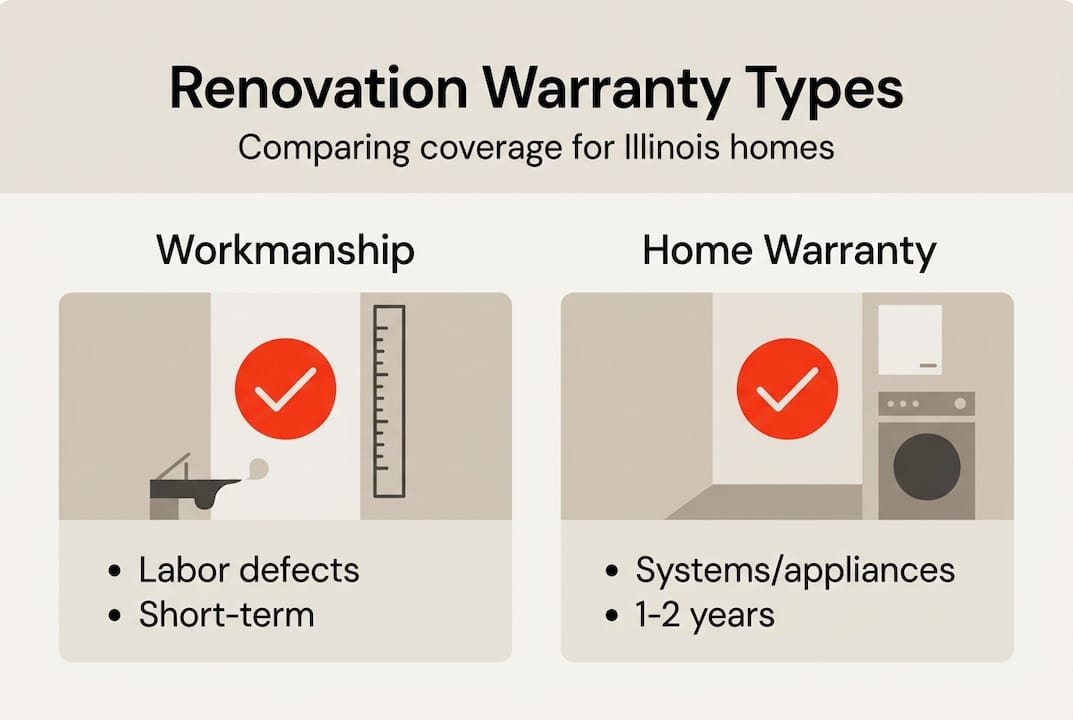
| Warranty type | What it covers | Typical duration |
|---|---|---|
| Renovation workmanship | Labor defects from the contractor’s work | 1 year (implied) or as written |
| Standard home warranty | Appliances, HVAC, plumbing wear and tear | 1 year, renewable |
| New construction 1-2-10 | Workmanship, systems, structural integrity | 1, 2, and 10 years |
The typical warranty process works like this: you notice a defect, you notify the contractor in writing, an inspection is scheduled, and if the defect falls within the warranty’s scope, the contractor repairs it at no charge. Simple enough in theory. In practice, the details matter enormously.
Common exclusions you will find in renovation warranties include:
- Normal wear and tear over time
- Damage caused by the homeowner’s misuse or neglect
- Natural disasters or acts of God
- Manufacturer defects in materials (those are covered by the product manufacturer, not the contractor)
- Work done by other parties after the original renovation
Understanding these exclusions before you sign is critical. Pair this knowledge with solid renovation contract protections to make sure your agreement reflects what you actually expect.
Pro Tip: Ask any contractor you’re considering for their warranty call-back rate. A low rate signals that their work holds up. A contractor who avoids the question may have a history of callbacks.
Illinois law and the implied renovation warranty
With the basics clarified, it is important to see how Illinois law actually shapes the renovation warranty you will get.
Illinois operates under the Home Repair and Remodeling Act (HRRA), which applies to any residential contract over $1,000. The HRRA sets ground rules for how contractors must operate, including written contract requirements and consumer notification obligations. But here is the part that surprises most homeowners: Illinois does not mandate express warranties for renovations. Instead, the state provides an implied warranty of habitability covering new work for at least one year.
An implied warranty means the protection exists automatically by law, even if it is never written into your contract. An express warranty is one that is explicitly stated in writing, with defined terms, duration, and scope. Most Illinois renovation contracts default to implied protection only, which means many homeowners are working with less specific coverage than they realize.
| Coverage type | Included in Illinois renovations | Notes |
|---|---|---|
| Implied warranty of habitability | Yes, automatically | Covers new work for at least 1 year |
| Express written warranty | Only if contractor provides one | Negotiate before signing |
| Subcontractor coverage | No (without privity) | Must have direct contract |
| Structural defect coverage | Varies by contract | Not automatically included |
The subcontractor issue is a significant gap. Without contract privity, meaning a direct agreement between you and the subcontractor, you cannot make an implied warranty claim against them. Your claim goes to the general contractor only.
Other important limitations in Illinois include:
- Working with an unlicensed contractor can void your warranty protections entirely
- Repairs made by someone other than the original contractor may void coverage
- The implied warranty does not cover pre-existing conditions or unrelated systems
For a full picture of what meets legal standards in 2026, review Illinois renovation standards before you finalize any agreement. Getting accurate renovation estimates from licensed contractors also helps you stay within a framework where these protections apply.
Common renovation warranty scenarios and coverage disputes
Understanding the law is only part of the story. Let’s see what actually happens when warranties are put to the test.
Here are three scenarios that reflect how warranty claims typically unfold for Illinois homeowners:
-
Successful repair claim: A homeowner notices tile grout cracking in a newly renovated bathroom eight months after completion. She notifies the contractor in writing, an inspection confirms the grout was improperly mixed, and the contractor repairs it at no cost within two weeks. Clean process, clear outcome.
-
Denied claim for misuse: A homeowner has new hardwood floors installed, then places a large fish tank directly on them without protective padding. The floors warp. The contractor inspects and denies the claim because improper maintenance voids coverage. The homeowner is responsible for the repair cost.
-
Coverage dispute over water intrusion: A homeowner discovers water damage behind a newly installed exterior door. The contractor argues it is a manufacturer defect in the door seal. The homeowner argues it is faulty installation. This dispute over water intrusion is one of the most common warranty disagreements contractors and homeowners face, and it often ends in mediation or legal action.
“The biggest mistake homeowners make is assuming the warranty covers everything. Read the exclusions first, document everything from day one, and never make repairs yourself without notifying the contractor in writing.” — Construction industry best practice guidance
Documentation is your strongest tool. Keep photos of the completed work, save all written communications, and hold onto every receipt. If a dispute arises, your paper trail determines whether your claim succeeds or fails.
Before inspecting renovation quality after your project wraps up, know what you are looking for. And always confirm that you are working with licensed contractor requirements met, since unlicensed work can strip away your legal protections entirely.

Pro Tip: Always send warranty-related notices by email or certified mail. A phone call is not documentation. Written records protect you if the dispute ever reaches a mediator or judge.
How Illinois homeowners can maximize protection
Knowing what is covered is not enough. The real advantage comes when you take these steps before, during, and after your renovation.
Before you sign anything, verify the following:
- Confirm the contractor holds a valid Illinois license
- Ask for proof of insurance, including general liability and workers’ compensation
- Request any express warranty terms in writing before signing
- Ask whether the contractor uses subcontractors and whether those subs are covered under the main warranty
- Confirm the contract meets HRRA requirements, including the statutory consumer rights brochure that contractors are required to provide
During the renovation, stay engaged. Walk the site regularly, take dated photos at each phase, and note any concerns in writing immediately. Do not wait until the project is complete to raise issues.
After the renovation, follow these steps to protect your coverage:
- Conduct a final walkthrough and document everything in writing before making final payment
- Request a written copy of all warranty terms if not already provided
- Create a dedicated renovation folder with your contract, receipts, photos, permits, and all written communications
- Follow any maintenance guidelines the contractor provides, since failure to do so can void your warranty
- If you discover a defect, notify the contractor in writing immediately and do not attempt repairs yourself
If a contractor refuses to honor a valid warranty claim, your options include filing a complaint with the Illinois Attorney General’s office, pursuing mediation, or taking the matter to small claims court for disputes under $10,000.
Getting organized before work begins is the smartest move you can make. Start with a solid plan by reviewing how to prepare for renovations and understanding what craftsmanship in remodeling should actually look like when the job is done right.
Why renovation warranty peace of mind starts with your contract
After years of navigating renovation projects across Illinois, here is what we have learned: most warranty headaches are not solved after a problem appears. They are prevented before the first tool is picked up.
Homeowners often focus on the warranty period length, asking if it is one year or two. But the more important question is whether your contract clearly defines what is covered, what is excluded, and what process you must follow to make a claim. An implied warranty gives you a legal floor, not a safety net.
The contractors who generate the fewest disputes are not necessarily the ones with the longest warranties. They are the ones with clear contracts, consistent workmanship, and a track record of following Illinois standards. A two-year warranty from a contractor with sloppy documentation habits is worth less than a one-year warranty from a contractor who runs a tight operation.
Our honest advice: spend more time vetting your contractor and reviewing your contract than worrying about warranty fine print. If the contract is solid and the contractor is reputable, the warranty almost never needs to be invoked. Start that process by planning a renovation with the right framework from day one.
Get renovation results and warranty confidence with Illinois experts
If you are ready to put these insights to work, do not start without the right team. At First Solution IL, we work with Illinois homeowners to ensure every project is backed by clear contracts, quality craftsmanship, and full transparency about what your coverage includes.

Explore remodeling project examples to see the standard of work we deliver, or walk through our remodeling workflow guide to understand exactly how we manage each phase. Ready to talk specifics? Learn more about our Illinois remodeling services and reach out for a free consultation. We make sure you know what you are getting before the project starts, not after a problem shows up.
Frequently asked questions
Is a renovation warranty required by law in Illinois?
Illinois does not mandate express warranties for renovations, but it does provide an implied warranty of habitability covering new work for at least one year. This protection applies automatically, even if it is not written into your contract.
What defects are typically covered under a renovation warranty?
Most warranties cover labor defects at no cost to the homeowner but exclude normal wear, misuse, natural disasters, and manufacturer defects, which are handled separately by the product maker.
How do I make a claim if I discover a defect after renovation?
Notify your contractor in writing as soon as you spot the issue, allow them to schedule an inspection, and give them a reasonable opportunity to make repairs before pursuing other remedies.
Can I sue a subcontractor if I find problems with their work in Illinois?
Without contract privity, meaning a direct agreement between you and the subcontractor, you generally cannot bring an implied warranty claim against them. Your legal claim goes to the general contractor you hired directly.