
TL;DR:
- Illinois relies on local licensing, making local verification essential before hiring.
- Proper insurance verification involves direct contact with insurance providers for active coverage.
- Neglecting credential checks risks legal issues, project delays, insurance denials, and property value loss.
Hiring the wrong contractor in Illinois can cost you far more than a low bid saves. Many property owners and investors assume that a friendly handshake and a cheap quote are enough to get started, but unpermitted and unlicensed work can trigger stop-work orders, invalid liens, insurance denials, and EPA fines reaching $44,539 per day. Illinois’s fragmented licensing system makes the problem worse because there’s no single state database to check. This guide walks you through how credentials work in Illinois, what insurance coverage you actually need, what legal consequences come from skipping verification, and exactly how to vet any contractor before signing a contract.
Table of Contents
- Understanding Illinois contractor credential requirements
- Insurance essentials: Protect yourself from liability
- Legal consequences and property value: Risks of poor credential vetting
- Practical steps for Illinois owners and investors: Effective vetting and verification
- The nuance most owners miss: Why local checks matter more than state licenses
- Next steps: How our Illinois experts streamline safe remodeling for you
- Frequently asked questions
Key Takeaways
| Point | Details |
|---|---|
| Local license checks matter | Illinois licensing is local, so always verify credentials in your project’s city or county. |
| Insurance protects owners | Require general liability and workers’ comp to shield yourself from lawsuits or damages. |
| Legal risks affect value | Unlicensed/uninsured contractors can cause fines, work stoppages, and decrease property value. |
| Practical vetting steps | Use IDFPR, request COIs, check complaint histories, and confirm all specialty credentials. |
Understanding Illinois contractor credential requirements
Illinois operates differently from most states when it comes to contractor licensing, and that difference catches a lot of property owners off guard. There is no statewide general contractor license in Illinois. Instead, licensing is controlled at the local level, which means a contractor who is fully registered in Aurora may have zero legal standing to pull permits in Chicago. Before you hire anyone, you need to know exactly where your project sits and what that municipality requires.
State-level licenses do exist, but only for specialty trades. Roofing and plumbing contractors must hold state-issued licenses regardless of where they work. For everything else, general remodeling, additions, and interior renovations, the rules come from the city or county. Chicago, for example, requires contractors to register with the city, carry specific insurance minimums, and maintain workers’ compensation coverage if they employ workers. Other localities have their own versions of these rules.
Why does this matter so much? Because a contractor who skips local registration cannot legally pull permits. No permits means no inspections, and no inspections means you have no third-party verification that the work meets code. Our license verification guide explains how to check credentials by jurisdiction so you know exactly what to look for before work starts.
Here’s a quick look at how Illinois’s credential structure breaks down:
| Contractor type | Who governs credentials | What to verify |
|---|---|---|
| General contractor | Local municipality | City/county registration, permit history |
| Roofer | State (IDFPR) | State roofing contractor license |
| Plumber | State (IDFPR) | State plumbing license |
| HVAC technician | State and local | EPA 608 cert, local registration |
The key things to confirm before hiring any contractor in Illinois:
- Local registration status for the specific city or county where your project is located
- State specialty license if the work involves roofing, plumbing, or HVAC
- Permit-pulling history to confirm they have successfully completed permitted work in that jurisdiction
- Workers’ compensation certificate if they employ anyone other than themselves
Our article on renovation licensing for safer projects goes deeper on how local rules vary across Illinois and why the importance of licensed contractors goes well beyond just following the law.
Insurance essentials: Protect yourself from liability
Once you understand credential requirements, insurance verification is the next vital step. This is where many property owners make a critical mistake: they accept an insurance certificate handed to them by the contractor. That document could be expired, altered, or issued under a policy that has since been canceled. The only way to confirm active coverage is to contact the insurer directly.
Uninsured contractors shift liability to property owners for injuries and damages. If a worker falls on your property and the contractor carries no workers’ compensation, you could be sued for medical costs and lost wages. If a subcontractor damages a neighboring property, you could be held responsible. These are not rare scenarios.

Here’s how the two main coverage types compare and what to require:
| Insurance type | Minimum to require | What it covers |
|---|---|---|
| General liability | $1,000,000 per occurrence | Property damage, third-party injury |
| Workers’ compensation | State-required amounts | Worker injuries on your property |
What you should require from every contractor:
- A Certificate of Insurance (COI) sent directly from the insurance carrier, not printed by the contractor
- Your name and address listed as an additional insured on their general liability policy
- Confirmation that the policy is active through the project completion date
- Written confirmation of workers’ compensation coverage if they have employees
Pro Tip: Call the insurance company listed on the COI to confirm the policy number, coverage limits, and expiration date. This takes five minutes and eliminates one of the biggest risks in any renovation project.
For a closer look at insurance benchmarks for contractors in Illinois commercial and residential work, and to understand why it pays to choose professional contractors who carry proper coverage, those resources break down exactly what adequate protection looks like.
Legal consequences and property value: Risks of poor credential vetting
Insurance alone isn’t enough. Neglecting credential checks introduces major legal and financial risks that can follow a property for years. The consequences are not abstract. They show up in title searches, affect your ability to sell, and can result in serious out-of-pocket costs.
“Unlicensed and unpermitted work doesn’t just create safety concerns. It can invalidate your mechanics lien rights, trigger government enforcement, and make your property harder to sell or refinance.”
Here are the most serious risks, ranked by how quickly they can derail a project or your finances:
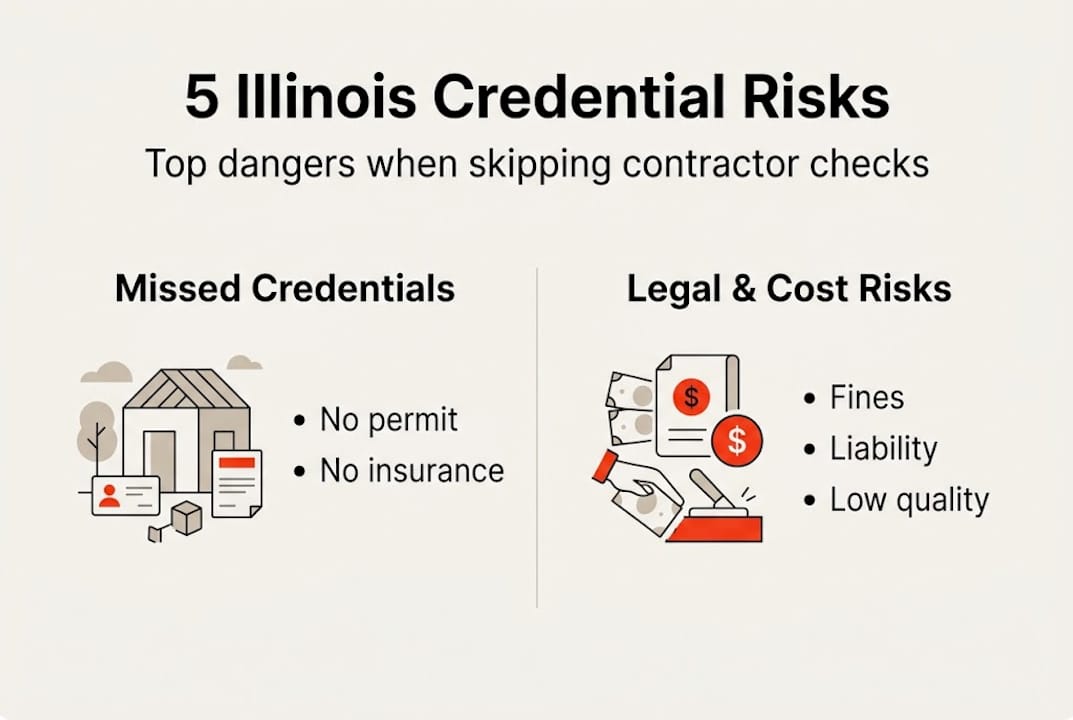
- Stop-work orders. A city inspector who discovers unpermitted work can halt your project immediately, sometimes for weeks while you resolve violations.
- Invalid mechanics liens. In Illinois, an unlicensed contractor may lose the right to file a valid mechanics lien, but more importantly, you lose legal protection in disputes over payment and workmanship.
- Insurance claim denials. If a fire or flood traces back to work done without permits by an uncredentialed contractor, your homeowner’s or commercial property insurer may deny the claim.
- EPA fines for lead violations. Work on pre-1978 properties requires EPA RRP (Renovation, Repair, and Painting) certification. EPA fines for lead violations can reach $44,539 per day per violation.
- Decreased property value and sale complications. Buyers’ attorneys and home inspectors flag unpermitted work. It either kills deals or forces price reductions.
Our building codes compliance guide covers the specific Illinois statutes that apply to renovation work, and our piece on contractor credibility insights explains how to spot red flags before a contract is signed.
Practical steps for Illinois owners and investors: Effective vetting and verification
Now that you understand the risks, here’s how to make sure your contractor’s credentials are solid before any work begins. This process takes less than two hours for most projects, and it can save you from months of legal and financial headaches.
- Look up state specialty licenses through IDFPR. The Illinois Department of Financial and Professional Regulation (IDFPR) maintains an online lookup tool for licensed roofers, plumbers, and other state-regulated trades. If your project involves those trades, this is your first stop.
- Check local registration with the city or county. Visit the municipality’s website or building department to confirm the contractor is registered to work and pull permits in that jurisdiction. Chicago’s online portal, for example, lets you search by contractor name.
- Request the COI directly from the insurer. Ask the contractor for their insurer’s name and policy number, then call the insurer yourself to confirm active coverage. Do not rely solely on documents provided by the contractor.
- Search BBB and Illinois Attorney General records. The Better Business Bureau and the Illinois AG’s consumer complaint database both list formal complaints. A pattern of unresolved issues is a serious warning sign.
- Call at least two references from similar projects. Ask specifically whether the work passed inspections, whether the contractor held proper permits, and whether there were any insurance issues during the job.
Pro Tip: For specialty work involving mold remediation or asbestos abatement, standard contractor licenses are not enough. Mold contractors in Illinois should hold IDPH and IICRC certifications, which are separate from general or roofing licenses.
Data shows that licensed contractors cut renovation defects significantly compared to unlicensed work, and understanding local contractor benefits makes it clear why jurisdiction familiarity matters for every project.
The nuance most owners miss: Why local checks matter more than state licenses
Here’s the perspective most guides skip: in Illinois, a state license is often the least important credential to verify. It sounds counterintuitive, but the state only governs a narrow slice of trade work. The real compliance risk lives at the local level.
We have seen projects stall not because a contractor lacked a state roofing license, but because they had never registered with a specific suburb’s building department. The work looked fine, the contractor had years of experience, but no local registration meant no permits, and no permits meant a stop-work order three weeks into a $60,000 renovation.
Illinois’s jurisdiction-specific contractor requirements create a patchwork that even experienced contractors sometimes navigate poorly. As a property owner or investor, the safest approach is to verify credentials at the local level first and treat state license checks as a secondary step for specialty trades. This protects your property value, keeps your timeline intact, and eliminates the single most common compliance gap we see on Illinois renovation projects.
For a full breakdown of what local contractor advantages look like in practice, that resource connects the dots between local knowledge and better project outcomes.
Next steps: How our Illinois experts streamline safe remodeling for you
If you’re ready to apply these credential vetting steps and start your next project with real confidence, our team at First Solution IL is built for exactly this.

We specialize in Illinois residential and commercial remodeling, and every project starts with thorough credential and insurance verification tailored to your specific locality. Our commercial remodeling guide and detailed remodeling workflow steps walk you through our process from first contact to final inspection. If you want to understand exactly how we handle contractor license verification before any work begins, that resource lays out the full process. Reach out today for a free consultation and let us take the credential risk off your plate.
Frequently asked questions
Do Illinois contractors need a statewide license?
No, Illinois does not have a statewide general contractor license; licensing is handled locally by cities and counties, with state-level licenses required only for specialty trades like roofing and plumbing.
What insurance should my Illinois contractor carry?
Your contractor should carry general liability insurance with a $1M minimum per occurrence and workers’ compensation coverage if they employ workers, and you should be listed as an additional insured on their general liability policy.
How can I verify a contractor’s credentials in Illinois?
Use the IDFPR online lookup for state specialty licenses, check local building department records for municipal registration, request a Certificate of Insurance directly from the insurer, and review complaint history through BBB and IICRC records.
What risks come with hiring unlicensed contractors?
Hiring an unlicensed contractor can result in stop-work orders and fines, invalid mechanics liens, denied insurance claims, EPA penalties up to $44,539 per day, and reduced property value that complicates future sales or refinancing.