
Planning a remodeling project in Illinois? Many homeowners underestimate costs, leading to at least 15% cost overruns. This guide clarifies budgeting misconceptions and provides Illinois-specific insights into financing options, cost factors, and proven strategies to keep your renovation on track financially. Whether you’re updating a kitchen or tackling a whole-home remodel, understanding accurate budgeting helps you avoid costly surprises and achieve quality results.
Table of Contents
- Introduction To Remodeling Budgeting
- Understanding Remodeling Costs In Illinois
- Financing Options For Remodeling Projects
- Common Budgeting Misconceptions And Mistakes
- Budgeting Best Practices And Contingency Planning
- Prioritizing Remodeling Expenses For Quality And Roi
- Applying Your Budget Understanding To Your Remodeling Project
- Discover Expert Remodeling Services Tailored For Illinois Homeowners
- Frequently Asked Questions
Key takeaways
| Point | Details |
|---|---|
| Remodeling costs vary greatly in Illinois | Labor and location factors create wide price ranges from Chicago metro to rural areas. |
| Multiple financing options exist | HELOCs, home equity loans, personal loans, and over 182 Illinois grant programs provide flexible funding. |
| Contingency budgets prevent stress | Budget at least 10-20% extra to cover unexpected expenses and scope changes. |
| Professional estimates improve accuracy | Avoid DIY budgeting pitfalls by getting multiple contractor quotes for realistic cost projections. |
| Prioritize high-ROI projects | Kitchen and bathroom remodels typically yield 55-75% return on investment. |
Introduction to remodeling budgeting
Remodeling budgeting is a specialized financial planning process focused exclusively on estimating all costs tied to home renovation projects. Unlike general household budgeting, it accounts for materials, labor, permits, design fees, financing costs, and contingencies specific to construction work. A solid budget prevents mid-project financial stress and scope creep, which occurs when projects expand beyond original plans without corresponding budget adjustments.
Several cost factors greatly impact final expenses. Material quality ranges from builder-grade to premium, with corresponding price variations. Labor rates fluctuate based on contractor expertise and regional demand. Permit fees and inspection costs add administrative expenses. Unexpected conditions like hidden water damage or outdated electrical systems often surface during demolition.
Clear scope definition is essential before estimating costs. Document exactly what work you want completed, which rooms are involved, and what finishes you prefer. Vague project descriptions lead to budget mismatches. For example, “update the kitchen” could mean anything from painting cabinets to a complete gut renovation. Defining remodeling services in Illinois helps establish clear project parameters from the start.
With that conceptual clarity, let’s dive into specifics of remodeling costs tailored for Illinois homeowners.
Understanding remodeling costs in Illinois
Remodeling costs depend heavily on project scope and scale. The average whole house remodel ranges from $15,000 to $200,000 depending on extent, with costs per square foot between $15 for minor updates and $150 for major gut renovations. Labor typically accounts for 30-50% of total remodeling expenses, making it a dominant cost factor.
Location within Illinois significantly affects pricing. Chicago metro area projects often run 20-35% higher than rural Illinois work due to elevated labor rates, stricter building codes, and material delivery costs. Suburban areas like Naperville or Schaumburg fall somewhere in the middle. Urban contractors charge premium rates reflecting higher overhead and specialized expertise.
Material quality and complexity also impact budgets. Stock cabinets cost $60-150 per linear foot while custom cabinetry runs $500-1,200. Laminate countertops start at $20 per square foot versus $100-200 for granite or quartz. Flooring options span from $3 vinyl planks to $15+ hardwood per square foot installed.
Common Illinois remodeling cost ranges:
- Kitchen remodel: $12,000-50,000
- Bathroom remodel: $6,000-25,000
- Basement finishing: $30-75 per square foot
- Room additions: $80-200 per square foot
- Exterior siding replacement: $8,000-24,000
| Project Type | Low End | Mid Range | High End |
|---|---|---|---|
| Minor kitchen update | $5,000 | $15,000 | $25,000 |
| Full kitchen remodel | $25,000 | $40,000 | $75,000+ |
| Bathroom refresh | $3,000 | $10,000 | $18,000 |
| Master bath remodel | $15,000 | $30,000 | $50,000+ |
| Basement finish | $20,000 | $45,000 | $80,000+ |
Pro Tip: Request itemized estimates breaking down labor, materials, permits, and overhead. This transparency helps identify where you can adjust specifications to meet budget constraints without sacrificing structural quality.
Understanding these cost components helps you build realistic expectations. Review remodeling services cost details and compare against average remodeling costs to validate your budget assumptions.
Now that you grasp costs, let’s explore practical financing options available for Illinois homeowners.
Financing options for remodeling projects
Several financing avenues exist for remodeling projects, each with distinct advantages. Home Equity Lines of Credit are used by 54% of homeowners for phased remodeling projects. HELOCs offer flexible borrowing where you draw funds as needed and pay interest only on amounts used. This works well for projects spanning several months where costs accumulate gradually.
Home equity loans provide lump sum disbursements with fixed interest rates, suited for full-project funding. You receive all money upfront and repay over a set term, typically 5-15 years. This option works best when you know exact project costs and prefer predictable monthly payments.
Personal loans require easier qualification since they’re unsecured, but often carry higher interest rates of 7-20%. They work for smaller projects under $35,000 or when you lack sufficient home equity. Approval happens quickly, sometimes within days, making personal loans attractive for time-sensitive renovations.
Illinois offers over 182 home repair grants prioritizing seniors, veterans, disabled, and low-income households. These grants are extensively underutilized despite providing thousands in free renovation funding. Eligibility typically requires income below area median levels and owner-occupied primary residence status.
Financing comparison:
| Option | Best For | Interest Rate | Repayment Term | Qualification |
|---|---|---|---|---|
| HELOC | Phased projects | 4-8% variable | 10-20 years | Good credit, 15%+ equity |
| Home Equity Loan | Full project funding | 5-9% fixed | 5-15 years | Good credit, 15%+ equity |
| Personal Loan | Small projects | 7-20% fixed | 2-7 years | Fair to good credit |
| Illinois Grants | Qualifying homeowners | 0% (free) | N/A | Income/status requirements |
Choosing the right option depends on project size, timeline, and credit situation. Large renovations exceeding $50,000 benefit from home equity products offering lower rates. Smaller projects under $20,000 may justify personal loans to avoid home liens. Explore financing remodeling with HELOCs and loans and investigate Illinois home improvement grants before committing to paid financing.
Understanding costs and financing is vital, yet many homeowners fall prey to budgeting misconceptions; let’s uncover and correct those.
Common budgeting misconceptions and mistakes
Assuming remodeling costs are fixed leads to surprise expenses. Most projects experience 15% or higher overruns due to unforeseen conditions like structural issues, permit delays, or material price fluctuations. Construction involves inherent uncertainties that rigid budgets cannot accommodate.

DIY budgeting often overlooks hidden complexities. DIY remodeling projects exceed budgets by 20-30% because homeowners underestimate labor hours, tool costs, permit requirements, and correction expenses for mistakes. What appears straightforward often involves electrical, plumbing, or structural work requiring licensed professionals.
Ignoring contingencies sets projects up for financial stress. Without buffer funds, unexpected expenses force difficult choices like stopping work mid-project, using credit cards at high interest, or accepting substandard solutions. These scenarios create far more stress than building contingencies upfront.
Failing to get professional estimates causes inaccurate budgets. Online calculators provide rough ranges but cannot account for your home’s specific conditions, local code requirements, or current material availability. Professional contractors assess actual site conditions and provide realistic numbers.
Common budgeting pitfalls:
- Believing all quotes should match exactly
- Assuming the lowest bid represents best value
- Forgetting to budget for temporary living arrangements during major work
- Underestimating permit and inspection fees
- Ignoring seasonal price variations for materials and labor
“The biggest mistake homeowners make is not planning for the unexpected. Every remodeling project uncovers something that wasn’t visible during initial planning. Budget flexibility prevents those discoveries from becoming project disasters.”
Another misconception involves grant accessibility. Many believe remodeling grants only help extremely low-income households or require complex applications. Actually, middle-income families often qualify for weatherization, accessibility, or historic preservation grants. The application process, while requiring documentation, is manageable for motivated homeowners.
Understand common renovation budgeting mistakes and recognize why budgeting errors hurt remodeling projects. Review remodeling cost overruns data and learn about DIY remodeling budget pitfalls to avoid these expensive traps.
With misconceptions addressed, let’s explore proven budgeting strategies including how to properly plan contingencies.
Budgeting best practices and contingency planning
Include a 10-20% contingency budget for unforeseen expenses. Straightforward projects like cosmetic updates can use 10% buffers, while structural work, older homes, or complex renovations warrant 15-20% contingencies. This buffer covers discovered issues without derailing your project or forcing compromised solutions.
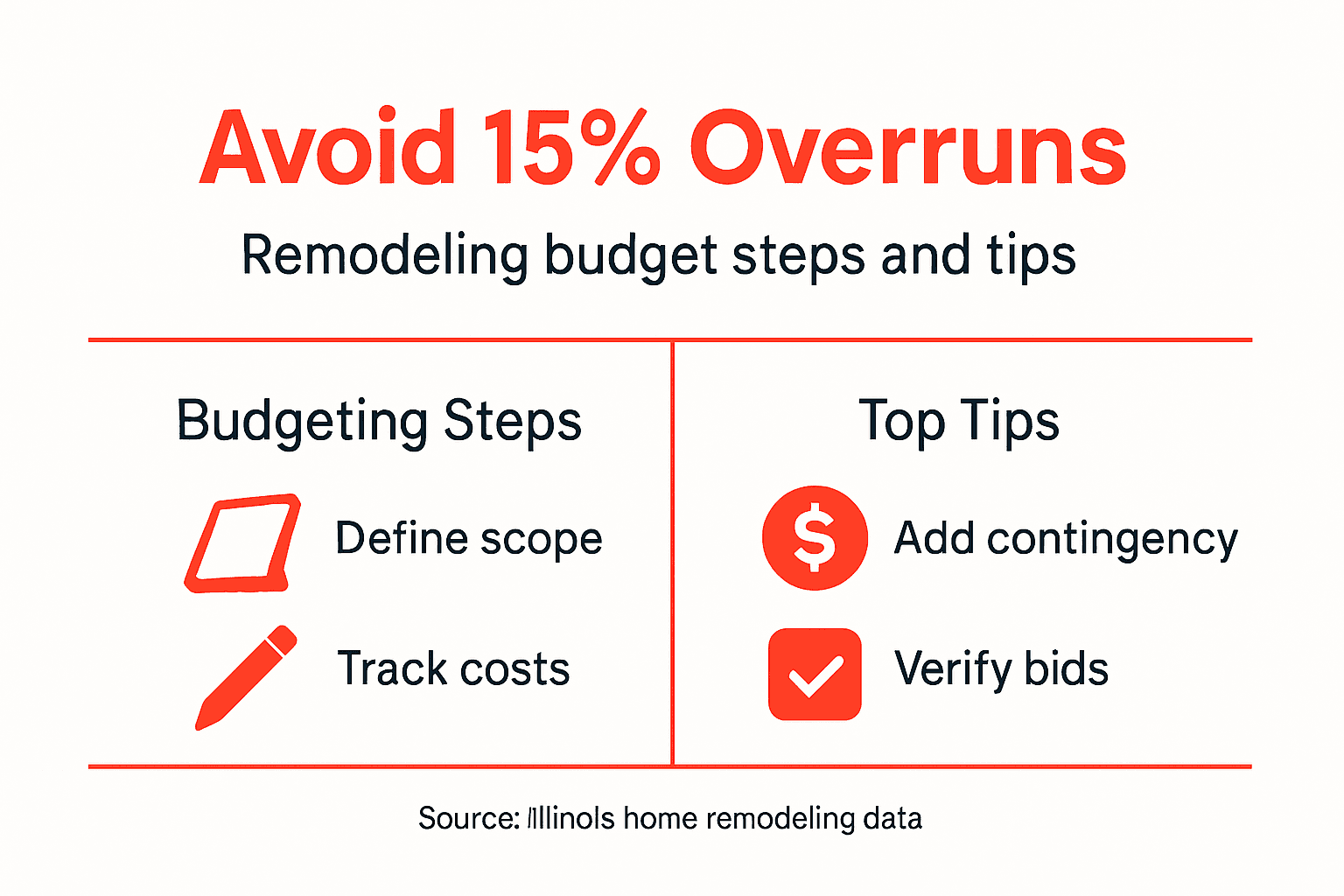
Define project scope in detail to avoid scope creep. Document every room, surface, fixture, and finish you want addressed. Specify appliance brands and models, flooring types, paint colors, and hardware styles. Detailed scopes let contractors provide accurate bids and reduce mid-project change orders that inflate costs.
Professional estimates improve accuracy and provide budgeting confidence. Budget preparation costs range between $900 and $1,100, covering professional assessment, planning, and detailed estimates. This upfront investment prevents much larger losses from inaccurate DIY budgets.
Essential budget preparation steps:
- Get at least three written estimates from licensed contractors
- Request itemized breakdowns of labor, materials, and overhead
- Verify all estimates include permits, inspections, and cleanup
- Ask about payment schedules and deposit requirements
- Clarify what scenarios might trigger additional charges
Budget preparation includes costs for planning, labor, materials, and site preparation. Planning encompasses design fees, architectural drawings if needed, and engineering consultations for structural changes. Site preparation covers demolition, debris removal, and protective measures for areas not under renovation.
Regular budget updates during the project improve financial control. Review spending weekly against your budget. Track change orders immediately and adjust remaining allocations. This ongoing monitoring catches overruns early when corrective action is still possible.
Pro Tip: Create a spreadsheet tracking estimated versus actual costs for each budget category. Update it after every contractor payment. This real-time visibility helps you make informed decisions about where to economize if certain areas run over.
Learn about remodeling budget preparation costs and validate estimates against budget preparation cost ranges for your specific Illinois location.
Beyond planning, prioritizing remodeling expenses wisely maximizes quality and return on investment.
Prioritizing remodeling expenses for quality and ROI
Kitchens and bathrooms typically yield 55-75% ROI on remodeling investment. These rooms strongly influence home value and buyer appeal. Kitchen updates recoup 50-70% of costs while bathroom remodels return 55-75%. Focus significant budget here if resale value matters to you.
Use quality materials and skilled labor to avoid costly fixes later. Cheap materials fail prematurely, requiring replacement within years instead of decades. Poor installation voids warranties and creates performance issues. Investing in mid-range to premium products and experienced contractors pays long-term dividends.
Plan phased upgrades to manage cash flow without sacrificing quality. Complete one room or system fully before starting another. This approach lets you save between phases, avoid large loans, and live in partially updated spaces more comfortably. Finish high-impact areas first for immediate enjoyment.
Project prioritization framework:
- Safety and structural issues (foundation, roof, electrical, plumbing)
- High-ROI updates (kitchen, bathrooms, curb appeal)
- Energy efficiency improvements (insulation, windows, HVAC)
- Comfort and lifestyle enhancements (finished basements, outdoor living)
- Aesthetic preferences (paint, fixtures, decorative elements)
Rank projects by impact, durability, and personal enjoyment. Impact considers how significantly a renovation improves home functionality or value. Durability weighs how long the improvement lasts before requiring replacement. Personal enjoyment reflects how much the update enhances your daily living experience.
- Address critical repairs before cosmetic improvements
- Choose mid-range finishes that balance quality and cost
- Focus on kitchens and bathrooms for maximum value
- Incorporate energy-efficient features for ongoing savings
- Select timeless designs over trendy styles for longevity
Incorporate energy-efficient and value-adding features where possible. LED lighting, programmable thermostats, low-flow fixtures, and improved insulation reduce utility costs while appealing to buyers. These features often qualify for rebates or tax credits, effectively lowering your net investment.
Explore high-ROI remodeling projects in Illinois to identify which renovations deliver best returns in your market.
Having prioritized your budget, apply this understanding practically with real-world tools and contractor selection tips.
Applying your budget understanding to your remodeling project
Use Illinois-specific remodeling cost estimation tools for accuracy. National averages don’t reflect Chicago metro premiums or downstate savings. Local tools account for regional labor rates, material availability, and permit fee structures specific to Illinois municipalities.
Practical budgeting steps:
- Define your complete project scope in writing
- Research typical costs using Illinois-focused resources
- Get at least three contractor quotes to compare
- Add 15% contingency to the highest reasonable estimate
- Secure financing before work begins
- Track spending weekly against your budget
Get at least three contractor quotes to compare and validate budgets. Wide variation between quotes signals either scope misunderstanding or quality differences. Extremely low bids often indicate inexperienced contractors or plans to upsell later. Extremely high bids may reflect premium services you don’t need.
Set realistic project timelines incorporating contingencies. Small bathroom remodels take 3-4 weeks. Full kitchen renovations require 6-10 weeks. Whole-home remodels span 3-6 months. Weather delays, permit processing, and material backorders add time. Build schedule buffers just like financial contingencies.
Update your budget regularly to reflect project changes. When you upgrade tile selections or add lighting fixtures, adjust remaining allocations immediately. This prevents end-of-project surprises where you’ve overspent without realizing it.
Pro Tip: Schedule a mid-project budget review with your contractor. Compare actual costs to estimates for completed work. Use this data to refine projections for remaining tasks and make adjustments before running out of funds.
Build financial safety nets to avoid stress from last-minute expenses. Maintain accessible emergency funds separate from your remodeling budget. Consider keeping one credit card with available balance for true emergencies, though avoid using it for routine project costs.
Learn about getting contractor estimates to validate your budget assumptions with professional input.
Now, connect these practical insights with professional services designed to simplify your remodeling journey.
Discover expert remodeling services tailored for Illinois homeowners
Planning a remodeling project requires balancing quality, budget, and timeline. First Solution IL specializes in helping Illinois homeowners navigate this complex process with professional estimates, transparent pricing, and expert project management.
Our team provides detailed budgeting support from initial planning through project completion. We help you understand realistic cost expectations, identify potential issues before they become expensive surprises, and make informed decisions about materials and methods. Professional guidance reduces stress and keeps your renovation on track financially.
Whether you need kitchen updates, bathroom remodels, flooring installation, or comprehensive home renovations, First Solution IL delivers quality craftsmanship backed by transparent communication. We understand Illinois building codes, regional cost factors, and financing options available to homeowners throughout the state.
Explore home remodeling and construction services in Illinois to see our full service range. Get accurate renovation estimates tailored to your specific project. Review DIY vs professional contractor guidance to make the best choice for your situation.
To round out your budgeting knowledge, here are answers to common remodeling budgeting questions Illinois homeowners ask.
Frequently asked questions
How much contingency should I include in my remodeling budget?
Experts recommend 10-20% contingency to cover unexpected costs. Straightforward cosmetic updates can use 10% buffers, while structural work or renovations in older homes warrant 15-20% contingencies. Without adequate reserves, surprise expenses like hidden water damage or code compliance upgrades force difficult mid-project compromises or costly delays.
What financing options work best for small remodeling projects in Illinois?
Small projects under $20,000 often benefit from cash savings or personal loans to avoid home liens and closing costs. Personal loans approve quickly and don’t require home appraisals. Larger or phased projects exceeding $30,000 typically justify HELOCs or home equity loans offering lower interest rates despite upfront costs. Always compare total costs including fees and interest over the full repayment term.
How do labor costs vary across Illinois regions?
Labor costs typically represent 30-50% of total remodeling budgets, varying significantly by location. Chicago metro area rates run 20-35% higher than rural Illinois due to elevated overhead, union requirements, and higher living costs. Suburban areas like Naperville or Schaumburg fall between these extremes. Always get local quotes rather than relying on statewide averages for accurate budgeting.
Can I qualify for remodeling grants in Illinois?
Yes, over 182 grant programs exist throughout Illinois, especially prioritizing seniors, veterans, disabled, and low-income homeowners. Many middle-income families qualify for weatherization, accessibility modifications, or historic preservation grants. Requirements typically include income below area median levels and owner-occupied primary residence status. Application processes require documentation but are manageable for motivated homeowners seeking free renovation funding.
What are common budgeting mistakes Illinois homeowners should avoid?
Ignoring contingency budgets and relying solely on DIY estimates are major pitfalls causing 15-30% cost overruns. Other mistakes include accepting the lowest bid without verifying credentials, forgetting permit and inspection fees, and failing to document scope details that lead to mismatched expectations. Professional quotes and realistic buffers protect your budget from these expensive traps.
How can I find reliable contractors offering accurate estimates in Illinois?
Request multiple bids from at least three licensed contractors to compare approaches and pricing. Check credentials including licenses, insurance, and bonding. Ask for references from recent projects similar to yours and actually contact them. Use local Illinois resources like Better Business Bureau ratings and online reviews to vet contractors effectively before committing to any agreements.