
TL;DR:
- Illinois licensing requirements vary by city and trade, requiring verification of credentials before hiring.
- Hiring unlicensed contractors can lead to insurance denials, legal liabilities, fines, and work violations.
- Verify licenses through official portals like IDFPR and local building departments to ensure contractor legitimacy.
Most property owners in Illinois assume that if someone shows up with a truck, tools, and a business card, they must be legitimate. That assumption can be costly. Hiring unlicensed contractors can lead to denied insurance claims, personal liability for on-site injuries, and work that fails city inspection. Illinois licensing rules are layered, mixing state requirements with local ordinances, and knowing the difference is the first step to protecting your investment. This guide walks you through what to check, how to check it, and what happens when you don’t.
Table of Contents
- Understanding Illinois contractor licensing: Why and what to check
- Risks of hiring unlicensed contractors in Illinois
- How to verify a contractor’s license in Illinois
- Common pitfalls and expert tips for safer hiring
- Our take: Licensing isn’t everything, but verification is essential
- Partner with Illinois-licensed professionals for peace of mind
- Frequently asked questions
Key Takeaways
| Point | Details |
|---|---|
| Licensing isn’t statewide | Illinois only requires state licenses for certain trades like roofing and plumbing, with local rules for other contractors. |
| Unlicensed hiring is risky | Owners face legal, financial, and safety risks if they skip license verification. |
| Verification is easy | You can check licenses through state and city portals before hiring to protect your project. |
| Expert vetting matters | Asking for insurance and checking disciplinary history adds extra safety beyond a basic license check. |
Understanding Illinois contractor licensing: Why and what to check
First, let’s clarify what licensing actually covers in Illinois. The answer is more complicated than most owners expect, and the complexity itself creates real risk.
Illinois lacks statewide general contractor licensing but does require state licenses for roofing and plumbing. Everything else, including general construction, electrical, HVAC, and tile work, is regulated at the city or county level. That means a contractor who is perfectly legal in one suburb may be operating without proper credentials in the next town over.
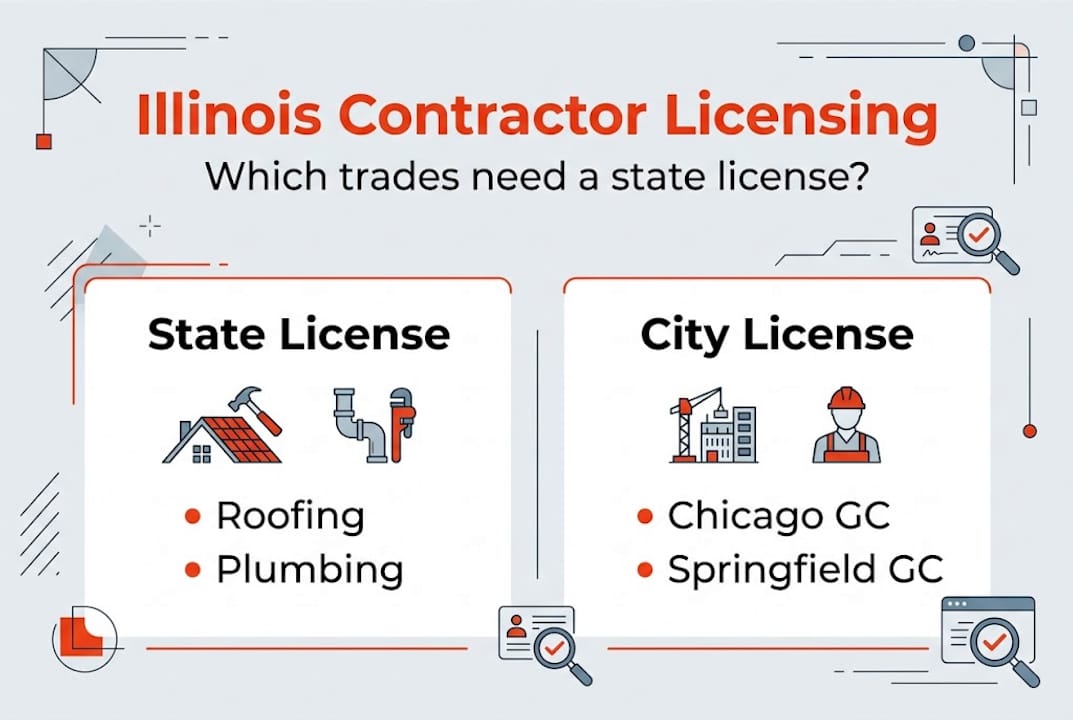
Understanding state licensing rules helps you know exactly which authority to contact before signing any contract. Here is a quick comparison of how major Illinois cities handle general contractor licensing:
| City | General contractor license required | Issuing authority |
|---|---|---|
| Chicago | Yes | Chicago Department of Buildings |
| Evanston | Yes | Evanston Community Development |
| Naperville | Yes (for permit work) | Naperville Development Services |
| Springfield | Varies by trade | City of Springfield |
| Rockford | Yes | Rockford Building Department |
The trades that do carry state requirements fall under the IDFPR licensing requirements, the Illinois Department of Financial and Professional Regulation. Roofers and plumbers must be verified there first, regardless of what city they work in.
Other trades to pay attention to include:
- Asbestos abatement contractors: Require state certification through the Illinois EPA
- Mold remediation professionals: Must meet state training and certification standards
- Electricians: Licensed at the local level in most Illinois jurisdictions
- HVAC technicians: Require EPA 608 certification for refrigerant handling, plus local business licensing
Pro Tip: Specialty work like asbestos removal or mold remediation carries its own certification requirements entirely separate from a standard contractor license. Always ask for the specific certification number and verify it independently before any such work begins.
When a trade is locally regulated, you should call the building department directly in the city where your property sits. Don’t rely on the contractor’s word alone. This one extra step takes about ten minutes and can save you enormous trouble later.
Risks of hiring unlicensed contractors in Illinois
Now that you understand the basics, consider what’s at stake if you overlook licensing.
The financial and legal consequences of hiring an unlicensed contractor in Illinois are serious and well-documented. Hiring unlicensed contractors exposes property owners to insurance denials, personal liability for worker injuries, fines from city inspectors, and void contracts with no legal recourse to recover funds.
Here are the most common consequences Illinois property owners face:
- Denied insurance claims: If your insurer discovers work was done by an unlicensed contractor, they can deny your claim outright
- Personal injury liability: You may become legally responsible for injuries sustained by unlicensed workers on your property
- Stop-work orders: Building officials can shut down an entire project mid-construction, leaving your property exposed
- Voided contracts: Courts may refuse to enforce agreements with unlicensed contractors, making legal recovery nearly impossible
- Code violations: Unpermitted or non-compliant work can require full demolition and redo at your expense
- Loss of resale value: Unpermitted work discovered during a sale can derail transactions or reduce your offer price
The key risks of unlicensed hiring extend beyond money. Safety is a direct concern. Roofing, for example, is one of the most dangerous trades in construction, and unlicensed operators are far less likely to follow fall protection protocols.
Safety data point: OSHA roofing safety statistics show that one Illinois roofing contractor alone accumulated over $1.8 million in fines over a decade for exposing workers to unsafe conditions. Unlicensed operators rarely face this level of accountability.
The licensed contractor benefits are clear: licensing creates a paper trail, insurance accountability, and a legal mechanism for complaint resolution. Without it, you are essentially on your own if something goes wrong.
How to verify a contractor’s license in Illinois
Avoiding risk starts with simple checks. Here’s how you can confirm a contractor’s legitimacy.
Verification is a process, not a single click. Follow these steps every time you hire for a significant project:
- Identify the trade: Determine whether the work falls under state licensing (roofing, plumbing) or local jurisdiction (general construction, electrical).
- Check the IDFPR database: For state-licensed trades, use the IDFPR license lookup to search by name, business, or license number.
- Contact your city’s building department: For locally regulated trades, call or visit your city’s permit and licensing portal to confirm the contractor holds an active local license.
- Review disciplinary history: Both the IDFPR and local portals often display complaint histories, suspensions, or prior violations. Read them.
- Request a Certificate of Insurance (COI): Ask for proof of general liability and workers’ compensation insurance before any work begins.
- Use third-party tools: Platforms offering LicensedCheck methods aggregate license data and flag discrepancies that manual searches might miss.
Key Illinois licensing portals to bookmark:
| Portal | What it covers | URL |
|---|---|---|
| IDFPR License Lookup | Roofing, plumbing, other state trades | idfpr.illinois.gov |
| Chicago DOB Contractor License | General contractors in Chicago | chicago.gov/depts/bldgs |
| Illinois EPA Certification | Asbestos, lead abatement | epa.illinois.gov |
| LicensedCheck | Aggregated multi-state data | licensedcheck.com |
Pro Tip: When you receive a COI, don’t just confirm it exists. Call the insurance company directly to verify the policy is active and hasn’t been canceled since the document was issued. Contractors sometimes present outdated certificates.
For a complete walkthrough of this process, the detailed license verification guide covers every step with specific portal instructions tailored to Illinois property owners.
Common pitfalls and expert tips for safer hiring
Even when you check licenses, some pitfalls catch even savvy owners.
Verification is necessary but not sufficient. Knowing the common traps helps you stay protected through the entire hiring process.
Roofing fraud remains an issue in Illinois, and IDFPR relies largely on public reporting to catch unlicensed operators. Storm chasers, contractors who flood neighborhoods after hail or wind events, are a particular concern. They often lack local licensing, carry minimal insurance, and disappear before defects become visible.
The most frequent mistakes Illinois property owners and investors make include:
- Accepting verbal assurances: Always request license numbers in writing and verify them yourself
- Skipping workers’ comp verification: If a worker gets hurt and your contractor carries no coverage, your homeowner’s policy may be on the hook
- Signing Assignment of Benefits (AOB) forms: These transfer your insurance rights to the contractor, limiting your control over claims and repairs
- Ignoring permit pulls: A licensed contractor should pull permits. If they ask you to pull the permit yourself, that’s a red flag
- Focusing only on price: The lowest bid often comes from someone cutting corners on licensing, insurance, or both
- Not checking for prior complaints: A current license doesn’t erase a history of unresolved disputes
For deeper guidance on evaluating proposals and red flags in contractor contracts, the contractor credibility tips resource covers the specific language and clauses to watch for.
Pro Tip: Before signing any contract, confirm in writing that you retain the right to cancel within three business days. Federal and Illinois law provides this right for many home improvement contracts. A contractor who resists this clause is showing you something important about how they operate.
If you encounter an unlicensed contractor operating in Illinois, report them to the IDFPR or your local building department. In some jurisdictions, code officials are required to act on verified complaints. Your report protects the next property owner who might not know to check.
Our take: Licensing isn’t everything, but verification is essential
With all these facts in mind, here’s our experienced perspective as renovation and compliance specialists.
We will be direct: a license does not guarantee that a contractor will show up on time, communicate well, or deliver craftsmanship you are proud of. Licensing ensures accountability and baseline competency, but it is not a gold-star endorsement of quality.
What it does do is create a legal framework for recourse. If something goes wrong with a licensed contractor, you have options: filing a complaint with a regulatory body, pursuing bond claims, or taking the matter to court with an enforceable contract. With an unlicensed contractor, those pathways largely disappear.
In our work across Illinois residential and commercial projects, we see the same pattern repeatedly. An owner skips verification to save a few hundred dollars upfront, then spends thousands fixing unpermitted work or fighting an insurance denial. Licensed work actually reduces renovation defects significantly, not because a license makes someone a craftsman, but because licensed contractors operate within an accountable system.
Verification is a ten-minute step that protects a decision worth tens of thousands of dollars. There is simply no good reason to skip it.
Partner with Illinois-licensed professionals for peace of mind
Ready to apply what you’ve learned? Here’s how to find a reliable Illinois-licensed contractor for your next project.
At First Solution IL, we hold all required Illinois licenses and carry full general liability and workers’ compensation coverage on every job. We believe property owners and investors deserve transparency from the first call.

Whether you are exploring commercial interior renovation expertise for an investment property or browsing home remodeling examples for your residence, our team is ready to walk you through our credentials before we discuss the project. See the full range of our remodeling services in Illinois and contact us today for a free, no-obligation estimate.
Frequently asked questions
Which trades require a state license in Illinois?
In Illinois, roofing and plumbing contractors must hold state licenses issued by IDFPR; most other trades are regulated at the city or county level.
What tools can I use to verify a contractor’s license in Illinois?
Use the IDFPR online lookup for state-licensed trades and your city’s building department portal, such as the Chicago DOB, for general contractor licenses.
What could happen if I hire an unlicensed contractor in Illinois?
You risk denied insurance claims, personal liability, fines, stop-work orders, and voided contracts with no path to recover funds.
Does a license guarantee quality work?
Licensing ensures accountability and a minimum competency standard, but it does not guarantee craftsmanship quality; always check reviews, references, and past project portfolios too.